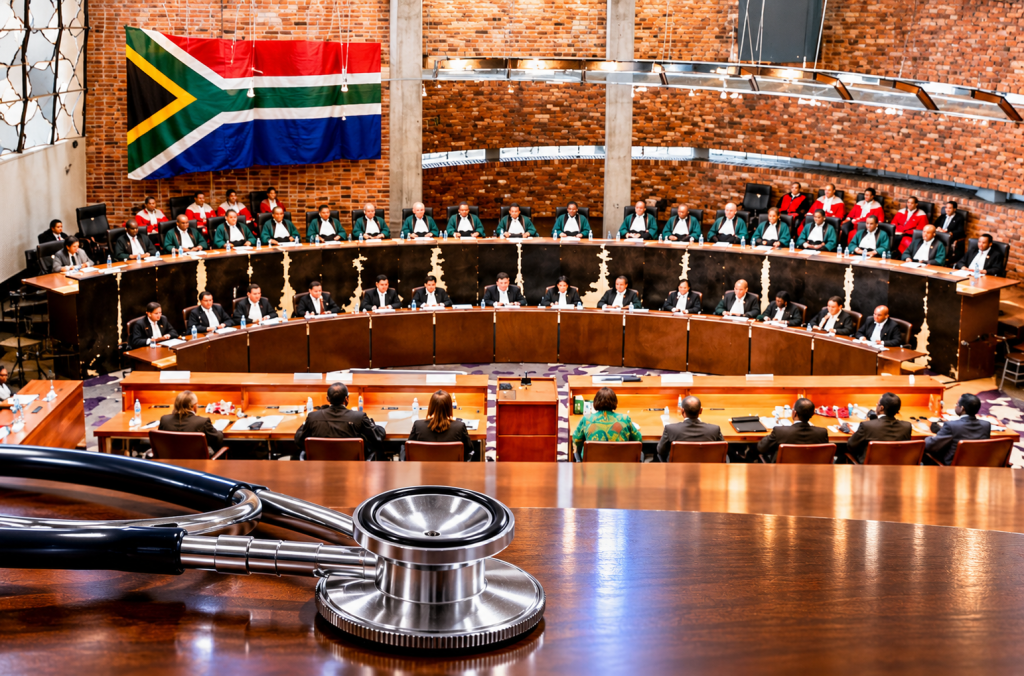
On Friday the Constitutional Court dismissed two challenges to the manner in which Parliament passed the National Health Insurance (NHI) Act. Those who expected a final determination of the NHI debate will be disappointed, because the judgment does not provide one.
The ruling concerns how the law was made. It does not decide whether NHI is wise, affordable or workable. The distinction is important, because the judgment will be claimed as vindication by supporters and opponents alike, and it supports neither claim as fully as each will suggest.
Think of it as the council confirming that the building plans were properly approved. That is useful to know. It does not tell you whether the house will stand, or whether the owners can afford the bond.
The purpose of NHI
In South Africa, the quality of your health care too often depends on your payslip. A minority use a well-resourced private sector. The majority queue at an under-resourced public system. Two systems, one flag.
The government presents NHI as the remedy. In broad terms, the Act establishes a single central fund to pay for health services delivered by accredited public and private providers, with care to be free at the point of use for eligible patients.
Two features of the Act remain particularly contested:
∙ the Act prohibits medical schemes from covering services that NHI provides; and
∙ the Act substantially reduces the role of provincial health departments.
Supporters regard the scheme as a measure of fairness and universal access. Critics raise concerns about its cost, its funding and the capacity of the State to deliver it. Supporters see fairness. Critics see a very large bill with no price tag attached.
How we got here
Parliament passed the Bill in December 2023, and the President signed it into law in May 2024. However, the Act has not yet come into effect.
Two challenges followed in the Constitutional Court. Both were directed at the public participation process that the Constitution requires in the making of legislation.
The Board of Healthcare Funders, which speaks for medical schemes and administrators, argued that Parliament only skimmed the submissions it received, and that the public was asked to comment on a plan without being told what it would cost, how it would be funded or what it would cover.
The Western Cape government confined its complaint to the National Council of Provinces. In effect, its message was: you let us speak, but did you listen? It also said requests for more time to comment were refused.
Parliament defended the process as extensive. The Minister of Health stated that it extended over four and a half years.
What the Court decided
The Court dismissed both challenges. It was unanimous in the matter brought by the Board of Healthcare Funders. In the Western Cape matter it was narrowly divided, with five of the 11 judges dissenting. Justice Steven Majiedt, who is retiring, announced the outcome.
A split of that kind tells us something. Reasonable minds, at the highest level, differed on whether the provincial input was properly weighed. Read more on this here.
The practical result is that the Act has not been set aside on public participation grounds and has not been referred back to Parliament for the process to be repeated.
At the time of writing, only the outcome and the division of the judges have been widely reported. This article therefore does not purport to describe the Court’s reasoning in detail. It is possible, however, to identify the questions the Court was required to decide:
∙ whether Parliament genuinely engaged with the submissions received and gave the public sufficient information to participate meaningfully; and
∙ whether the NCOP properly considered the Western Cape’s input, which the province contends reached the select committee only after the decisive stages had passed.
Sections 59 and 72 of the Constitution require the National Assembly and the NCOP respectively to facilitate public involvement in their legislative processes. The enquiry is whether reasonable steps were taken to do so. It is not whether every objection raised was accepted.
Distinction from the earlier health judgment
Earlier this year, in Solidarity Trade Union and Others v Minister of Health and Others, the Constitutional Court struck down the certificate of need provisions of the National Health Act, which would have allowed the State to control where health professionals may practise. That judgment concerned a different statute and a different question.
It addressed what those provisions said and how they limited the rights of health professionals. Friday’s judgment concerns how the NHI Act was made.
The Department of Health maintains that the earlier ruling does not affect the NHI Act, while others argue that it weakens the centralised design on which NHI relies. That disagreement remains unresolved.
What it means for you
As reported, the NHI Act is not yet in operation. Your medical aid card still works. Your clinic is where it was yesterday. Nothing changes because of this judgment.
The legal fight now moves to substance. Other challenges to the Act were paused while this case was pending, and they may now resume. Those cases are likely to test what the Act contains and how it affects rights.
The question of money remains wide open. The Court has said the process passed constitutional scrutiny. It has not said that NHI is affordable.
NHI is a good idea. Now do the sums.
Let me say plainly where I stand on the principle. Section 27 of the Constitution gives everyone the right to have access to health care services. A scheme that sets out to widen that access, and to narrow the gap between the private ward and the public queue, is aiming at the right target.
A sound principle is not, however, a funding model. The details must now be resolved openly and with rigour, in particular:
∙ what NHI will cost, who will pay and how;
∙ what will become of persons on medical schemes, and of the schemes themselves;
∙ how provinces, which administer the clinics and hospitals, will fit within a more centralised design; and
∙ whether public facilities and staff are equipped to carry the commitment.
The point may be put simply:
A promise is a seed, the budget is the rain;
the garden needs them both, or waits in vain.
The Court has determined how the law was made. Whether it delivers better health care to those it is intended to serve is the question that now remains.





Leave a Reply