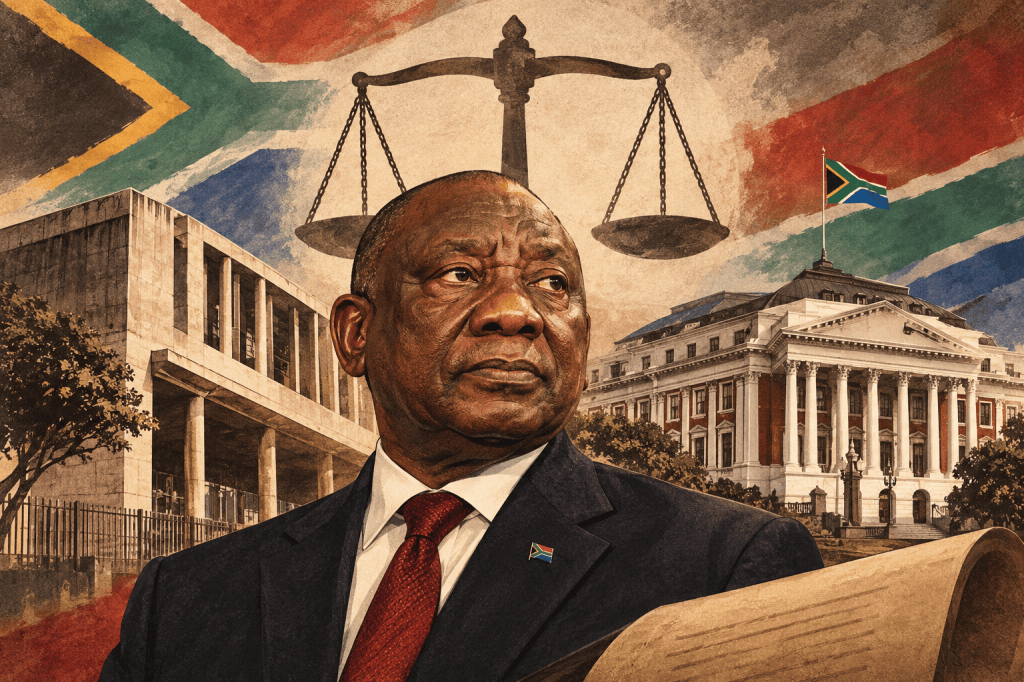
Amid the grandeur of juridical vindication lies an uncomfortable constitutional paradox: the President has won his legal battle, but the Republic’s pursuit of accountability remains an unfinished enterprise.
“The Constitution demands that all decisions be capable of being substantively defended in terms of the rights and values that it enshrines.” – Former Chief Justice Pius Langa, Transformative Constitutionalism (2006).
There are moments in the life of a constitutional democracy when the triumph of a legal argument does not necessarily occasion the triumph of a constitutional ideal. There are times when court rulings clash with the public’s expectations of accountability. Even when someone’s legal rights are upheld, the bigger questions that sparked the controversy may still remain unanswered. The judgment delivered by the Western Cape High Court on 25 November 2026 represents one such moment.
In a comprehensive 94-page judgment, Judge President Nolwazi Mabindla-Boqwana, sitting with Judges Mark Sher and Ncumisa Mayosi, declared the report of the independent Section 89 Panel, chaired by former Chief Justice Sandile Ngcobo, unlawful and set it aside, together with the consequential parliamentary proceedings. At paragraph 299, the court concluded:
“The Panel fundamentally misconstrued its functions, the nature of the enquiry it was to conduct, and the recommendation it was required to make to the Speaker.”
For President Cyril Ramaphosa, this constitutes a formidable juridical victory, at least for now. For Parliament, it necessitates uncomfortable institutional introspection.
For constitutional scholars, it presents a fascinating jurisprudential conundrum. For ordinary South Africans, however, it resurrects a considerably more elementary question: after years of political theatrics, parliamentary deliberations and judicial peregrinations, are we any closer to meaningful accountability?
I find myself occupying a somewhat uncomfortable intellectual position. I appreciate the legal reasoning underpinning the judgment, yet harbour considerable reservations about its broader constitutional ramifications. A judgment may be jurisprudentially defensible yet institutionally disquieting. The law may have spoken, but the constitutional conversation is far from concluded.
The constitutional gatekeeper or the undertaker of accountability?
What began as a burglary at a Limpopo game farm has transformed into one of the most consequential constitutional controversies of the post-Zuma political dispensation. The furniture has long since receded into the background. The constitutional furniture of the Republic is now itself under interrogation. At the epicentre of the judgment lies a seemingly innocuous but consequential controversy concerning the meaning of prima facie evidence and sufficient evidence within Parliament’s Rules.
Simply put, the independent panel understood its responsibility principally as determining whether the President had a case to answer. The President’s legal representatives argued that the panel was obliged to undertake a more comprehensive assessment of the evidence, including the President’s own explanations. The court agreed, identifying material errors in the panel’s interpretation of its mandate, its reliance upon inadequately substantiated information and its assessment of the charges. There is considerable legal merit in this reasoning.
Repeating an allegation, no matter how shocking, does not make it evidence. Speculation does not become fact simply because people strongly believe it, and making dramatic statements does not make a weak or unsupported claim credible.
Nevertheless, my jurisprudential discomfort arises from a fundamental question: how much evidence should be required to justify an inquiry into possible presidential culpability?
The independent panel was a preliminary screening mechanism, bereft of the investigative arsenal available to the impeachment committee. It could not conduct oral hearings or subject competing versions to the forensic rigours of cross-examination. Although the court did not require conclusive proof of wrongdoing, an excessively onerous preliminary threshold risks occasioning a jurisdictional inversion, expecting one institution to resolve questions that another institution was specifically constituted to investigate.
The constitutional gatekeeper must guard against frivolity without becoming the undertaker of legitimate inquiry.
Having a case to answer is not synonymous with having a case decided against you.
Referral is not removal. Investigation is not conviction. Scrutiny is not persecution. The maxim audi alteram partem, hear the other side, remains indispensable. But procedural fairness must facilitate the pursuit of truth, not inadvertently render that pursuit prohibitive. The Constitution must neither become a sword for political persecution nor a shield against legitimate scrutiny.
From Nkandla to Phala Phala: A Shakespearean irony
In his seminal exposition on transformative constitutionalism, former Chief Justice Pius Langa invoked legal scholar Etienne Mureinik’s vision of a constitutional order founded upon a culture of justification, in which every exercise of public power must be capable of being justified. This represented a repudiation of the authoritarian antecedents of our constitutional history. Public authority would no longer command obedience merely because it possessed power; it would derive legitimacy from its capacity to justify its exercise.
A decade later, in the landmark Nkandla judgment of 2016, former Chief Justice Mogoeng Mogoeng described the Presidency as “the highest calling to the highest office in the land”. The subsequent Constitutional Court judgment in EFF v Speaker of the National Assembly in 2017 compelled Parliament to establish appropriate rules governing presidential removal proceedings.
The independent panel mechanism was born out of this constitutional history. Therein lies the Shakespearean irony: a mechanism conceived to remedy parliamentary inertia has itself become entangled in a protracted jurisprudential odyssey concerning the boundaries of presidential accountability.
In May 2026, the Constitutional Court invalidated the parliamentary rule and decision that had prevented the Phala Phala report from progressing to an impeachment committee. The Western Cape High Court has now invalidated the report itself. Importantly, the High Court has not overturned the Constitutional Court’s judgment. The two courts were seized with distinct legal questions. Their practical consequences, however, are extraordinary. The Constitutional Court removed the obstacle preventing the report from progressing. The High Court has removed the report that was supposed to progress.
One is reminded of Sisyphus, the mythological figure condemned to perpetually roll a boulder uphill, only to watch it descend upon approaching the summit. Parliamentary accountability appears to have acquired its own Sisyphean characteristics. Have we inadvertently exchanged the tyranny of parliamentary arithmetic for the paralysis of procedural contestation? The Republic cannot perpetually oscillate between parliamentary impotence and judicial intervention while substantive accountability remains the elusive epilogue.
The politics of perception and the jurisprudence of impartiality
I do not wish to venture too extensively into the much-publicised narrative advanced by sections of the political opposition that the country’s number one citizen seldom finds himself on the losing end of litigation before our courts. However politically seductive that proposition may be, it cannot substitute for a dispassionate examination of judicial reasoning.
Successive favourable judgments do not, ipso facto, constitute evidence of judicial partiality. Judicial independence cannot be measured through an arithmetic distribution of victories and defeats. Indeed, it would be a jurisprudential absurdity to expect courts to occasionally rule against a particular litigant merely to demonstrate their impartiality.
The scales of justice are not an electoral scoreboard.
Nevertheless, it would be equally imprudent to dismiss the political optics associated with perceived patterns of favourable judicial outcomes, particularly where the accountability of the most powerful office bearer in the Republic is concerned.
Public confidence is the intangible currency of judicial legitimacy. Although courts cannot adjudicate according to the caprices of popular sentiment, the institutional importance of maintaining that confidence cannot be overstated. The appropriate response is not to indulge in unsubstantiated insinuations of judicial impropriety, but to interrogate the reasoning of judgments, test their fidelity to established legal principles and, where warranted, pursue appellate remedies.
A favourable judgment is not necessarily evidence of judicial capture, just as an unfavourable judgment is not necessarily a certificate of judicial independence.
We must distinguish between questioning the correctness of a judgment and impugning the integrity of its author. Judicial independence is indispensable. Judicial infallibility is a fiction. The existence of appellate courts is itself an institutional acknowledgment that even the most distinguished judicial minds are susceptible to error. Respect for judicial authority must never be confused with compulsory intellectual genuflection.
Judicial guardianship or constitutional substitution?
The principle of legality, entrenched in the landmark Fedsure and Pharmaceutical Manufacturers judgments, requires every institution exercising public power to operate within the confines of its lawful mandate.
The Ngcobo Panel could not enjoy immunity from that principle. Former Chief Justices are not infallible. Eminent advocates are not impervious to legal error. Jurisprudential pedigree cannot operate as an indemnity against the consequences of acting ultra vires, beyond one’s lawful powers.
It would be intellectually inconsistent to demand that the President submit himself to the rule of law while suggesting that the institutions established to scrutinise him should be exempt from its operation. Equally, judicial review must not become an appeal masquerading under a different jurisprudential nomenclature. Whether aspects of the High Court’s extensive evidentiary assessment approached the boundary between reviewing the lawfulness of a decision and substituting its own assessment for that of the panel may furnish fertile terrain for appellate adjudication.
There is also the question of judicial intervention in medias res – in the midst of an incomplete parliamentary process. The court considered the report to be the legal foundation of the impeachment proceedings and therefore susceptible to immediate review. That reasoning is not devoid of merit. Nevertheless, judicial restraint must not become a euphemism for constitutional timidity, nor should judicial vigilance metastasise into institutional omnipotence.
The judiciary is the guardian of constitutional legality. Parliament is the principal forum for executive accountability. Their functions intersect, but they are not interchangeable. A constitutional democracy cannot indefinitely outsource its parliamentary conscience to the judiciary. Moreover, the demise of a particular impeachment process does not absolve Parliament of its broader constitutional oversight obligations under sections 42, 55 and 92 of the Constitution.
Section 89 is an exceptional mechanism for presidential removal; it is not the entirety of parliamentary accountability. The collapse of one constitutional avenue must not become an alibi for institutional abdication.
The tyranny of procedural time
Section 237 of the Constitution provides: “All constitutional obligations must be performed diligently and without delay.” This provision is neither a ceremonial incantation nor an ornamental appendage to the constitutional text. More than four years after Phala Phala entered the public domain, we remain embroiled in litigation concerning the mechanisms through which the President ought to account.
I would be exceptionally surprised if the present judgment represents the final chapter of this constitutional saga. Applications for leave to appeal must ordinarily be brought within 15 court days. Further litigation-related developments before the conclusion of 2026 are therefore conceivable.
The ordinary appellate trajectory could lead to the Supreme Court of Appeal, subject to leave being granted. Alternatively, a direct appeal to the Constitutional Court may be pursued with the requisite permission. I suspect that the matter will ultimately return to the apex court, where much of its constitutional history was written. Absent expedited proceedings, finality could conceivably materialise in late 2027 or even 2028.
Ramaphosa’s presidential term ordinarily concludes in 2029.
Therein lies the constitutional predicament: the constitutional clock may ultimately outrun the judicial clock. We may eventually determine, with admirable jurisprudential precision, how a President ought to be held accountable, only to discover that the opportunity to invoke that mechanism against the particular incumbent has substantially diminished.
Time is not an innocent bystander in constitutional litigation. It can become the silent executioner of otherwise meaningful remedies. The maxim ubi jus ibi remedium – where there is a right, there is a remedy – loses much of its practical significance when the remedy arrives after the opportunity for its meaningful exercise has dissipated.
Accountability deferred beyond its practical utility risks becoming accountability ceremonially acknowledged but substantively denied. The Republic deserves more than magnificent jurisprudence accompanied by institutional procrastination.
Beyond juridical vindication: The nobility of statesmanship
The President has successfully challenged the legality of the independent panel’s report. The court’s findings concerning evidentiary deficiencies deserve recognition and should not be trivialised as mere technicalities.
However, the judgment is not an omnibus declaration of innocence in respect of every controversy associated with Phala Phala. Equally, unanswered questions cannot be transmuted into a presumption of presidential guilt.
The former proposition guards against political triumphalism; the latter guards against political persecution. Juridical vindication is not necessarily political clearance, and neither is invariably synonymous with the restoration of public confidence.
In Shakespeare’s Julius Caesar, we encounter the observation:
“The abuse of greatness is, when it disjoins remorse from power.”
The enduring relevance of that observation lies in its recognition that the possession of authority must be accompanied by a heightened consciousness of responsibility. In corporate governance, we distinguish between compliance and ethical leadership. Compliance concerns itself with what the law requires of you; ethical leadership concerns itself with what responsible stewardship demands of you.
The President should, in my considered view, seize this opportunity to voluntarily take South Africans into his confidence. He has previously furnished explanations concerning Phala Phala. Nevertheless, consolidating those explanations into a comprehensive, coherent and accessible public account, insofar as legally permissible, would constitute an admirable exercise in statesmanship.
It would neither amount to an admission of wrongdoing nor necessitate the abandonment of his constitutional protections. Transparency need not be a concession extracted through litigation. It can be a voluntary expression of ethical leadership.
Courts can vindicate legality, but they cannot restore public trust by judicial decree alone.
The constitutional statesman does not merely ask what the law permits him to withhold. He also asks what the dignity of his office requires him to disclose. Legality is the minimum threshold of leadership; legitimacy demands considerably more.
The Constitution must outlive its protagonists
Perhaps the greatest disservice we could render to the constitutional significance of Phala Phala would be to reduce it to a referendum on the political fortunes of Cyril Ramaphosa.
The principles that animated our demands for presidential accountability during the Zuma administration cannot become expendable merely because a different individual occupies the Presidency.
Equally, the procedural protections we insist upon for a President with whom we sympathise cannot be withheld from one whose politics we find objectionable.
The Constitution is not an ideological chameleon whose normative complexion changes according to the political identity of the person invoking it.
Constitutional fidelity is most meaningful when it is politically inconvenient.
Fiat justitia ruat caelum – let justice be done though the heavens fall.
Ultimately, the streets will be divided. There will be celebrations in some quarters, lamentations in others, further litigation and the inevitable political pontification.
Life will invariably go on.
But beyond the ephemeral theatre of political contestation lies an enduring constitutional imperative: protecting the President against unlawful processes must coexist with protecting the Republic against the erosion of meaningful accountability.
Neither imperative should be sacrificed at the altar of the other.
We must resist the temptation to become a Republic that produces magnificent judgments on accountability while struggling to produce accountability itself. President Ramaphosa has secured a formidable juridical victory, at least for now. He has an opportunity to secure an even greater moral and political victory by demonstrating that his commitment to accountability transcends the outcome of his litigation.
For Presidents will come and go, parliamentary majorities will rise and dissipate, political allegiances will undergo their inevitable metamorphoses, and judgments will eventually assume their place in the annals of our jurisprudence.
But the constitutional promise of an accountable government must outlive them all.
Let the President enjoy the juridical fruits of his successful litigation. Let Parliament rediscover its constitutional conscience. Let the judiciary continue to discharge its mandate without fear, favour or prejudice.
But let none of these developments occasion the premature interment of the Republic’s legitimate interest in presidential accountability.
The report has fallen. The Constitution’s demand for accountability must not fall with it.
Leo Ndumiso Maphosa is a corporate-commercial lawyer, Company Secretary and governance specialist. He writes in his personal capacity. The views expressed are his own.





Leave a Reply