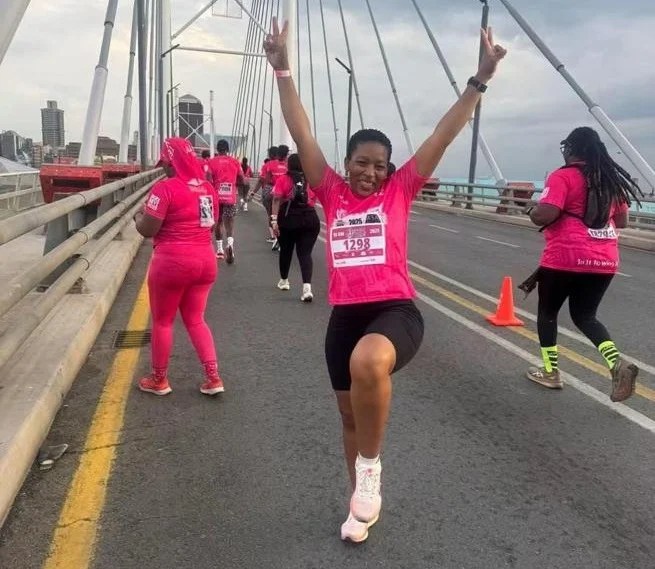
There was nothing she should have done differently. Nothing Uyinene should have done differently. Nothing Tshegofatso should have done differently. At some point, a country must stop teaching women how not to be murdered and start asking itself why it keeps producing people prepared to murder them.
Elizabeth “Tsontso” Moselakgomo went for a run.
There is something about the sheer ordinariness of that sentence that makes everything that follows almost unbearable.
She did not walk knowingly towards danger. She did not volunteer for an encounter with evil. She was not participating in some reckless excursion from which society may retrospectively manufacture a lesson about female prudence. She went for a run. A woman left her home to exercise and expected, as millions of human beings reasonably do every day, to return to it.
She did not.
Her eight-year-old daughter was the one who eventually became worried when her mother failed to come home and contacted relatives.
A search followed. Police made enquiries. A community hoped. A family waited. Then came the news that has become horrifyingly familiar in this country. A woman’s body had been found.
And on Monday, the unbearable administrative machinery of death required a family to go to the Germiston mortuary and answer the question every family of a missing person dreads.
It was Elizabeth. She was 38 years old.
And suddenly a woman who had been a mother, friend, relative, runner and an entire human universe became another name in a national conversation about murdered women. That is the first injustice we must resist.
Elizabeth must not become merely a statistic.
Before she was a headline, she was a person. Before there was a police docket, there was a life. Before South Africa knew the name “Elizabeth Moselakgomo” because something terrible had happened to her, there were people who knew Tsontso because they loved her.
And somewhere, most painfully, there is an eight-year-old child for whom all the national debates about policing, femicide, criminal justice and social pathology collapse into one infinitely simpler tragedy: Mom is not coming home.
There was nothing she should have done better.
Perhaps that needs to be said first, plainly and without qualification. There was absolutely nothing these women should have done “better”. Because whenever a woman is murdered in South Africa, we seem almost instinctively to begin conducting a post-mortem not only on her body, but on her choices. Why was she there? Why was she alone? Why did she trust him?
Why did she go running then? Why did she get into that vehicle? Why didn’t she share her location? Why didn’t she leave him earlier? Why didn’t she report him? Why did she meet someone she had spoken to online? Why didn’t she see the signs? Why? Why? Why?
The questions accumulate until, almost imperceptibly, the person whose conduct is being interrogated most intensely is the person who is dead. We have taught South African women an entire curriculum for surviving society.
Share your location. Watch your drink. Photograph the registration plate. Check the driver’s details. Don’t walk alone. Don’t run alone. Don’t arrive alone. Don’t leave alone. Call when you get there. Call when you leave. Carry something for protection. Don’t wear earphones. Stay somewhere well-lit. Tell somebody where you are. Be suspicious of strangers.
And because the statistics tell us that danger frequently comes from people already known to women, we must now apparently add: Be suspicious of the familiar too.
The latest official crime statistics recorded 9,782 rapes in South Africa between January and March 2026 alone. Nearly half, 4,620, or 47.2% occurred at the home of the victim or perpetrator.
So where exactly is this mythical safe place to which women are forever being instructed to retreat? The street can be dangerous. The taxi can be dangerous. The workplace can be dangerous. The date can be dangerous. And sometimes home itself is dangerous.
At some point we must confront the absurdity of requiring women to live like intelligence operatives merely to participate in ordinary human life. Safety cannot permanently be outsourced to the potential victim.
Elizabeth went running. Uyinene Mrwetyana went to collect a parcel. She was 19. In August 2019, the University of Cape Town student entered a post office, an institution of the state, during the course of an entirely mundane errand and was raped and murdered by an employee of that institution.
Her death shook South Africa. We marched. We posted. We cried. We said enough. The government itself described her killing as evidence of a breakdown in the country’s moral fibre.
And then came more names.
Tshegofatso Pule.
Nosicelo Mtebeni.
Hillary Gardee.
Namhla Mtwa.
Dimpho Skelenge.
Anene Booysen.
Little Bokgabo Poo.
So many others whose names never became hashtags at all.
The Presidency itself recited many of these names at the second Presidential Summit on Gender-Based Violence and Femicide in 2022.
Tshegofatso Pule was murdered in 2020 while pregnant. Justice eventually came, but the Commission for Gender Equality noted that her family waited two years for the criminal process to conclude and warned of systemic difficulties including weak investigations, disappearing witnesses, prosecutorial changes and delays in securing court dates.
Anene Booysen was only 17 when she was raped and murdered in Bredasdorp in 2013. The country recoiled at the brutality then too. We said never again then too.
And yet here we are. Another decade. Another woman. Another family. Another mortuary. Another statement of condemnation. Another promise that no stone will be left unturned. How many stones can remain unturned after all these years?
The numbers have names
Statistics are necessary because they tell us that what appears episodic is structural. But statistics are also dangerous because numbers can anesthetise.
Nine hundred and fifty-seven women were murdered in South Africa in just the three months between July and September 2024. In that same quarter, 1,567 women survived attempted murder, while 14,366 suffered assaults resulting in grievous bodily harm. (HSRC)
The HSRC’s first national gender-based violence study found that approximately one in three South African women over 18 had experienced physical violence in their lifetime.
Government has translated the underlying survey estimates into approximately 7.3 million women having experienced physical violence and 2.1 million sexual violence. (HSRC)
Parliament was told in February 2026 that South Africa’s femicide rate stood at approximately nine per 100,000 women, around five times the global average. (Parliament of South Africa)
The South African Medical Research Council’s national femicide research is more chilling still.
In its study of 2020/21, 60.1% of murdered women were killed by intimate partners. Roughly one in five were killed by friends, acquaintances or others. Family members accounted for another 10.9%. (SAMRC)
Read those figures slowly.
Because they demolish one of our most comforting myths. Danger does not always arrive wearing the face of a stranger. Sometimes evil already has your telephone number. Sometimes it knows your children. Sometimes it has eaten at your table. Sometimes your family knows it. Sometimes your friends know it. Sometimes everyone knows. And sometimes everybody remains silent.
The frightening question of consequence
There is another statistic from the SAMRC research that deserves considerably more national outrage. In the 2020/21 femicide study, a perpetrator was not identified during the police investigation in about 44% of cases.
The SAMRC also reported that fewer than one in five intimate-partner femicide cases resulted in a conviction. (SAMRC) That should terrify us. Because criminality does not flourish merely because wicked people exist. Every society contains people capable of wickedness.
Criminality flourishes when wickedness begins calculating that the probability of consequence is tolerably low. Law does not eliminate evil. It changes its arithmetic.
Effective policing says: we will find you.
Effective prosecution says: we can prove what you did.
An efficient court says: your victim will not disappear beneath postponements and procedural entropy.
A functioning correctional system says: there are consequences.
And a morally serious society says: You will not hide amongst us.
That last institution, society itself, receives too little scrutiny.
Because the perpetrators live amongst us
Joseph Conrad, confronting another species of human depravity in Heart of Darkness, reduced the encounter with evil to four immortal words: “The horror! The horror!”
There are moments when elaborate language becomes inadequate. This is one of them. The horror is not simply that people capable of this exist. The greater horror is their proximity.
They do not descend upon South Africa from some distant hell. They live amongst us.
The man capable of terrible violence is somebody’s son. Somebody’s brother. Somebody’s boyfriend. Somebody’s husband. Somebody’s friend. Somebody’s employee. Somebody’s colleague. Somebody’s neighbour. Somebody’s drinking companion. And this forces an uncomfortable question upon families and communities. What do we do when the criminal is one of ours?
Too often, kinship becomes an informal immunity. How can I send my own child to jail? That’s my brother. That’s my friend. We cannot destroy his future. But what of the future he destroyed?
There is a grotesque inversion of morality whenever society becomes more concerned about the consequences awaiting the perpetrator than the consequences already visited upon the victim.
Love cannot mean concealing evidence. Family cannot mean intimidating complainants. Friendship cannot require manufacturing alibis. Community cannot mean knowing who terrorises women and whispering his name only behind closed doors.
Sometimes the highest expression of love available to a family is the courage to say: I love you, but I will not protect you from accountability for what you have done. Otherwise, the victim effectively suffers twice: first from the perpetrator and then from the ecosystem assembled to protect him.
Yes, men are victims of violence too
At this point someone will understandably object that violence is not exclusively visited upon women. That is correct. Men constitute a substantial majority of murder victims in South Africa, and any serious account of our violent society must acknowledge that.
During January to March 2026, 5,181 people were murdered in South Africa, an average of about 58 people every day. SAPS recorded 6,916 attempted murders, 43,576 assaults with intent to cause grievous bodily harm and 26,796 aggravated robberies during that quarter. (Government of South Africa)
These are not women’s statistics. They are South Africa’s stats. So yes: we have a gender-based violence crisis. But we also have a violence crisis. And beneath both sits an even broader crisis of criminality.
That distinction matters precisely because acknowledging one does not diminish the other. The particular vulnerability of women to sexual violence, intimate-partner violence and femicide deserves particular analysis and intervention.
A society capable of holding more than one thought simultaneously should not require us to erase murdered men in order to speak about murdered women, or to erase the gendered character of violence against women in order to acknowledge male victims.
The correct conclusion is more frightening: South Africa has developed an extraordinarily intimate relationship with violence.
Our problem is bigger than murder
The murderer who concludes that another human life is disposable. The rapist who regards another person’s body as an entitlement. The hijacker prepared to exchange somebody’s life for a motor vehicle. The extortionist demanding a “protection fee” from somebody trying to operate an honest business.
The construction mafia demanding a share of work it never performed. The syndicate stripping copper, railway infrastructure or electricity equipment intended to serve an entire community. The corrupt official converting public money into private wealth.
The sophisticated businessman or woman stealing millions and sanitising theft beneath the vocabulary of transactions.
The ordinary citizen knowingly buying stolen goods because the price is attractive. The neighbour who knows exactly who the local criminals are but reasons that “they don’t trouble us.”
These acts are not legally identical. They are not morally identical. And it would be intellectually careless to pretend that they are. But they can flourish within the same moral ecosystem.
The ecosystem of entitlement without obligation; appetite without restraint; wrongdoing without shame; and, most dangerously, conduct without anticipated consequence.
One man empties somebody’s house. Another empties the public purse. One carries a firearm. Another carries a briefcase. The methodologies differ enormously. But somewhere in the moral architecture of each is the same corrosive proposition: My prosperity, pleasure, survival or enrichment may legitimately be purchased at somebody else’s expense.
That is how a society begins to decay. Not spectacularly. Incrementally. One bribe. One stolen item. One protected abuser. One falsified tender. One unreported criminal. One intimidated witness. One police docket that disappears. One investigation conducted incompetently. One prosecution that collapses. One neighbour who decides not to get involved. One family that chooses reputation over truth. One unanswered murder at a time.
We cannot legislate our way out of moral collapse
South Africa does not suffer from an absence of laws. We have a sophisticated constitutional order. We have domestic-violence legislation. Sexual-offences legislation. Protection orders. Specialised courts. Thuthuzela Care Centres. A National Strategic Plan on Gender-Based Violence and Femicide.
Indeed, GBVF was formally classified as a national disaster in November 2025, placing an enhanced obligation on the national government to coordinate the response.
The framework expressly envisages stronger Sexual Offences Courts, expansion of Thuthuzela Care Centres, justice-system reform and coordinated interventions across policing, health, social development and communities.
The architecture exists. The question is whether it reaches a frightened woman at 11pm. Whether the detective assigned to her case has the resources and competence to investigate it. Whether a protection order becomes actual protection.
Whether forensic evidence returns before witnesses disappear. Whether a prosecutor has a trial-ready docket. Whether repeat violent offenders are identified early. Whether somebody actually reads the warning signs before they become an obituary.
What must change – practically
We require more than hashtags, summits and beautifully drafted communiqués. Every unexplained murder of a woman within a geographic cluster should trigger rapid crime-pattern analysis before another body appears.
That means immediate cross-docket comparison, geographic profiling, CCTV harvesting, cellphone and digital-evidence preservation, forensic coordination and behavioural analysis.
Cases involving serial or predatory characteristics require specialised investigators who remain with them. Detectives cannot be expected to solve sophisticated violent crime while drowning beneath impossible caseloads. Forensic turnaround times must become measurable public-performance indicators. Evidence delayed can become justice denied.
Police stations must have properly trained GBVF personnel on every shift, not merely officials whose names appear on an organogram. Protection-order breaches must be treated as potential precursors to escalation rather than administrative irritations.
Prosecutors, detectives, forensic services and victim-support personnel must work from integrated case-management systems so that accountability does not depend upon a complainant carrying pieces of paper between institutions.
Repeat violent offenders require better flagging across policing and justice databases.
And communities must become active intelligence networks for lawful policing not vigilantes, but citizens prepared to report what they know. Employers must take credible allegations of violence seriously.
Schools must teach boys far more than the slogan “don’t hit women”. We must teach emotional regulation, consent, conflict resolution, dignity, rejection without humiliation, and that masculinity is not authenticated through domination.
Families must stop protecting perpetrators.
Men must begin policing the moral boundaries of male friendship. The misogynistic joke, the casual threat against a girlfriend, the boast about coercion, the friend whose violence everybody knows about, these are not always harmless eccentricities. Sometimes they are information.
And the state must publish outcomes, not merely initiatives:
How many GBVF dockets became prosecutions?
How many prosecutions became convictions?
How long did forensic testing take?
How many protection orders were breached?
How many repeat offenders were involved?
Which police stations are failing?
Which are succeeding?
Accountability requires names, numbers, deadlines and consequence.
But this is also about us
Government must be interrogated relentlessly.
Police capacity matters.
Detective quality matters.
Crime intelligence matters.
Prosecutorial competence matters.
Courts matter.
Sentencing matters.
Prisons matter.
Consequence matters.
But society must interrogate itself too.
What have we normalised?
What do we laugh about?
Whose violence do we excuse because he is talented, wealthy, useful, charismatic or one of ours?
Why do we condemn corruption in government and then celebrate the friend who “made a plan”?
Why do we condemn thieves but knowingly purchase stolen goods?
Why do we condemn abusive men publicly but invite them to Sunday lunch privately?
Why does criminality become intolerable only when we become its victims?
Institutions do not float above society.
Police officers come from our homes.
Prosecutors come from our communities.
Politicians come from our neighbourhoods.
Criminals do too.
The state is, ultimately, populated by the moral material society supplies it.
And now, Elizabeth
Robert G. Ingersoll once stood at his brother’s grave and wrote of life’s finality: “A wreck at last must mark the end of each and all.”
Death is indeed the unavoidable destination of every life. But there is an enormous moral difference between mortality and murder. Elizabeth was always mortal. She was not disposable. Death eventually comes for all of us. Violence had no right to hurry her towards it.
There were still ordinary mornings that belonged to her. Runs still to complete. Birthdays still to celebrate.
Arguments still to have. Meals still to cook. Friends still to laugh with. Plans still sitting somewhere in the future under the entirely reasonable assumption that she would be there to fulfil them.
And, above everything else, there was a little girl who had every reason to believe that when her mother went running, her mother would come home.
That is what violence steals. Not simply biological life. It steals the unwritten chapters. It steals birthdays before they happen. Conversations before they are spoken. Graduations a mother will never attend.
Photographs that will never be taken. Private jokes that will never be invented. Christmases that will contain an empty chair. A child’s future memories. It converts a person from presence into remembrance. And then it leaves everybody else to perform the impossible labour of learning how to live around the absence.
Do not tell the next woman merely to be careful
There will understandably be warnings after Kempton Park. Indeed, SAPS has urged women in the area, particularly around Rhodesfield, to exercise caution while investigators examine the concerning similarities between the deaths.
A specialised multidisciplinary team involving detectives, forensic resources and investigative psychology has been assembled. Importantly, police have cautioned that it remains premature to conclude that the deaths are connected or the work of one perpetrator.
Women should heed sensible safety information. But that cannot become our national solution.
Because there is something profoundly perverse about a society responding to male violence primarily by reducing female freedom. Don’t run there. Don’t walk there. Don’t dress like that. Don’t go out then. Don’t trust him. Don’t meet him. Don’t live alone. Don’t travel alone.
Don’t exist too freely. Eventually we must ask: Where are women permitted simply to live?
Elizabeth went for a run.
Uyinene went to collect a parcel.
Others were sleeping in their homes.
Others were with men they loved.
Others were at work.
Others were children.
There is no behavioural modification capable of guaranteeing survival in a society where another human being has decided that your life is negotiable.
The principal intervention must therefore move upstream: from managing potential victims to identifying, deterring, prosecuting and changing potential perpetrators.
Let her name remain
Elizabeth “Tsontso” Moselakgomo.
Say it.
Not “the Kempton Park body”.
Not “another female victim”.
Not “number four”.
Not another statistic in the next quarterly presentation.
Elizabeth.
A person.
A mother.
A woman who went running.
A human being entitled to the constitutional promises South Africa makes so beautifully on paper: dignity, freedom and security of the person, bodily integrity and, most elementary of all, life.
We failed to keep that promise to her. The most dignified tribute we can offer is not to pretend otherwise. Nor should we romanticise her death into some sacrificial moment from which the nation will magically awaken. We have buried too many women after declaring that this one must finally change us.
Instead, let remembrance become obligation. Let detectives find answers. Let prosecutors, if evidence identifies those responsible, prosecute without fear or favour. Let courts dispense justice efficiently and fairly. Let government measure what works. Let communities surrender perpetrators rather than conceal them.
Let families understand that blood relationship is not a licence to obstruct justice. Let men interrogate the conduct of other men before women have to pay for our silence. Let us construct a society in which a woman going for an evening run is so utterly unremarkable that her child need never be taught to fear that she may not return.
Because Elizabeth did not need to run differently.
Uyinene did not need to collect her parcel differently.
Tshegofatso did not need to live differently.
Anene did not need to be seventeen differently.
They needed the people who harmed them not to harm them.
Everything else begins there.
Conrad’s fictional Kurtz looked into an abyss of human depravity and could ultimately articulate only: “The horror! The horror!”
South Africa has looked into that abyss often enough.
Our task now cannot merely be to describe the horror more eloquently.
It must be to make horror dangerous for those who perpetrate it through detection, prosecution, social condemnation and consequence while making ordinary life safer for those who have done absolutely nothing to deserve it.
For today, however, before policy and politics consume another woman’s name, there should also simply be grief.
For Elizabeth.
For those who loved Tsontso before the rest of us knew her name.
For a family that had to enter a mortuary hoping against hope.
And most painfully, for an eight-year-old girl who waited for her mother to return from a run.
She should have.
May Elizabeth “Tsontso” Moselakgomo rest in peace.
And may South Africa finally understand that the measure of our outrage is not how loudly we mourn women after they have been killed, but how seriously we reorganise society so that fewer families ever have to mourn them at all.


 The Joburg Reporter
Leave a comment