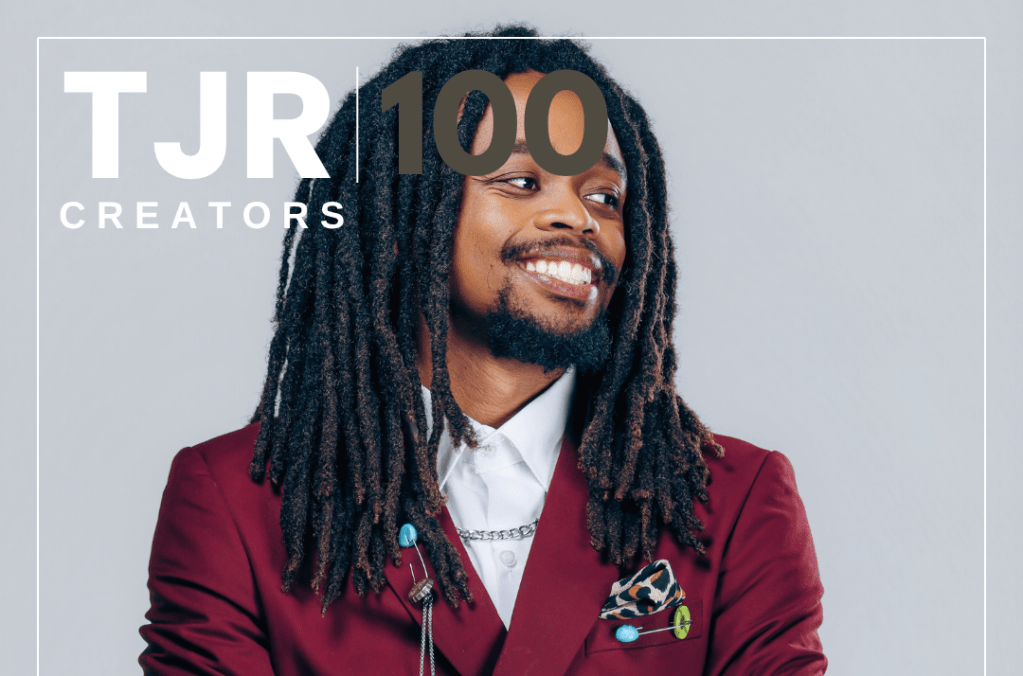
In the media industry, actors and on-screen personalities often receive the most recognition, it is easy to forget the people doing much of the heavy lifting behind the scenes.
Nqanawe Shangase is a storyteller who has spent much of his career behind the camera, bringing ideas to life and helping us see the world — and ourselves — through the stories he tells.
But behind the writer, director, producer, editor and critic is a man with his own story.
As part of TJR 100 Creators, we are passionate about shining a spotlight on these storytellers too — the people behind the scenes whose creativity and vision shape the stories we consume.
This is Nqanawe Shangase.
Who is Nqanawe Shangase when the cameras are off and you’re not creating stories?
Pretty much the same person I am when the cameras are on and I’m telling stories. One of the things I’ve strived for the most my entire life, has been to minimise the gap between who I portray myself to be, and who I really am.
As an artist, storyteller, and especially as a filmmaker – it’s almost mandatory to live like that, if you are to create anything worth being made. Art is expression of self & interpretation of the world/life – therefore, a life approached untruthfully or half-assedly, is bound to make the art untruthful in its nature, too.
And at my core – I’m someone with a keen interest in unpacking & exploring humanity, human nature & morality – who wants to live life to its fullest before my time comes.
So when the cameras are off and I’m not creating stories, I’m living life. Being a father. A partner. A student of life. Watching movies. Eating good food and taking it one day at a time.
You started NqanaweLIVE in 2017. What gap did you see in South Africa’s film industry that inspired you to create it?
The lack of a mutually appreciative connection between storytellers and those who they tell stories to, beyond basic supply & demand.
My mission has and always will be to de-exclusify film. Because that’s the only thing standing between us and the actualising of a true film culture, locally.
It’s difficult for anyone to earnestly engage with something they don’t fully know about. And so, since the first video on the NqanaweLIVE YouTube Channel, I’ve always invited the people/audience on the journey to learning more about (local) film & filmmaking, beyond just engaging with it for pure entertainment value.
Doing that ensures we can build a culture of appreciation – as more and more people will feel involved in the art they consume, and will have the vocabulary to appropriately discourse it – regardless of whether they like it or not. And ultimately, what that does, is convert more people into fans of cinema. Which is something I believe everybody wishes for.
You’ve worn almost every hat in the industry; journalist, critic, writer, director, producer and editor. Which role feels most like home, and why?
A few years ago, I would’ve given a simpler answer than the one I’m about to give. And that’s because all of the hats I’ve worn are quite intertwined with each other. I’ve been writing since I was 10.
I wouldn’t have ever decided to become a director had that not been the case. But directing is not one thing. It’s something you truly become over time & experience.
You have to acquire other skills & traits, if you’re to be a director that’s worth their salt.
The more proficient you are at other adjacent roles & disciplines, the more refined of a director you become. And so, learning how to logistically put together the means to produce anything (short film, YouTube video, doccie) – you have to know how to produce. One way or another. Otherwise you’ll never get anything made.
That’s how I became a producer – through necessity. When I was starting out, I didn’t really have much of a network to rely on. So I had to shoot stuff myself, and ultimately learn how to edit my own stuff. That’s how I became an editor – necessity.
Editing turned out to be what would give me my first industry credit and open me up to a world of more professional work. Through my passion for telling stories about humanity – I ended up veering into the world of journalism where I got trained & upskilled as a journalist.
Currently, with THE UBANI TOUR – I’m learning so much about film distribution. Yet – all of this was and still is in service of being a (better) director.
So, the simpler answer would’ve been: directing. But, I don’t become the director I’m so proud of being today, if I don’t wear all these other hats that have fully coloured me in.
As both a filmmaker and a film critic, how do you balance celebrating South African cinema while also being honest about where it needs to improve?
This used to be quite a challenge starting out because I was still unknown, uncredited and thus untrusted by some. So, I kind of had to be very careful with how I leveled my critiques. But, being an honest person, what that did was – it forced me to learn how to still communicate what I wanted to communicate, without ever spooking anyone.
I learnt how to give balanced criticism that doesn’t pander nor slander, without ever offending anyone. Over time, that just became my reputation.
The guy whose opinion on cinema you can trust. Which is the privilege I now live in. Where everybody knows me and trusts me. Which affords me the ability to always keep my voice & integrity, because everybody knows I mean well.
I’m certain it affected my filmmaking career in the earlier years, in terms of getting job opportunities – but I’m proud I never censored one aspect of myself in favour of the other.
I am respected more today because I stayed unwavering in that. People always warm up to good work fueled by good intentions.
What inspired the short film, UBANI LORE? And where can people watch it?
“UBANI LORE?” is inspired by our legendary South African icons of yesteryears and those of today, and the work they have blessed us with. Growing up watching movies, you realise how good Hollywood is at referencing, celebrating, championing & mythologising their own icons and their works.
It’s something I’ve always admired, and it really hurt me how we never got to see much of such on our screens, about our own icons. And so, much like almost everything I’ve ever done in my film career, I decided to once again be the change I want to see by making a short film that does exactly that.
We have a banging website at ubanilore.co.za and so any and all relevant information about the film and the tour can be found there.
See you on tour!
You wrote and directed QUANTUM, a film about on undocumented migrants. Not long after, South Africa saw widespread anti-illegal migration protests. As a storyteller, what went through your mind watching real-world events echo themes you’d already explored?
That more people need to listen to what I have to say. Haha. Jokes aside – it reinforced in me why I really need to carry on being responsible when telling stories. When I wrote QUANTUM, even when I was still pitching it to SABC/NFVF – I always emphasised that it was a cautionary tale.
The point of cautionary tales is for them to warn people of what may happen and potentially curb it or prevent it altogether. I didn’t thumbsuck QUANTUM. I looked at my country and wrote what I was observing and feared would happen. And it did.
If someone watched just one of your films to understand who Nqanawe Shangase is as a filmmaker, which one should they watch and why?
With the four films I’ve made – I haven’t even begun to scratch the surface to reveal who I am or what I’m about. Both QUANTUM & UBANI LORE? are so unique – you would think two separate filmmakers made them.
One film is a time-loop, crime thriller about doing the right thing and the other is a surrealist comedy celebrating South African icons and their work.
The stuff I have coming in the near future is vastly different from any of these two. And so, I’d say to understand me better, at any given point in my career – try to see all of my work. It gives one a clearer image of who I am and what I’m about.
What story about South Africa do you believe still hasn’t been told properly, and why is it important that someone tells it?
There is a bottomless well filled with these. South Africa is still pretty young in the game of cinema. Film has been around since the 1910s, but till this day, a proper industry hasn’t really formed around it. And we only got TV in 1976.
There are more stories we haven’t told than ones we have. And more important than stories that haven’t been told before, are perspectives we haven’t gotten to see enough of yet.
Even if it’s on the same stories we’ve seen before. That’s what I’m more excited about, and that’s what I offer as a filmmaker, artist & storyteller. A fresh & arresting/compelling perspective.
Quick fire Qs
● Favourite SA film of all time? Hijack Stories (dir. Oliver Schmitz, 2000)
● One actor you’d love to direct. – Only one?! Clementine Mosimane ● Cinema or streaming? – Cinema. Cinema. Cinema!
● Favourite place in South Africa to shoot – Anywhere, honestly. South Africa is one of the best places to shoot in, in the entire world. Ask Hollywood.
● Last film that made you cry. – Films: The Odyssey (dir. Christopher Nolan, 2026), Beau Is Afraid (dir. Ari Aster, 2023) – TV Show: DTF St. Louis (dir. Steven Conrad, 2026)
● Coffee or energy drinks during editing? – At some point, I was on both. But now, neither.
Who do you want us to feature next? Nominate them here!



Leave a Reply