Before asking whether The Popi Show belongs on Netflix or television, perhaps the more interesting question is: what happens when a creator builds a show that is already working without either?
In an hour-long phone conversation for our TJR 100 Creators campaign, Popi Sibiya opened up about what happens behind the social media posts; from the decision to leave conventional employment and build her own platform, to navigating brands, money and the challenge of remaining true to her concept.
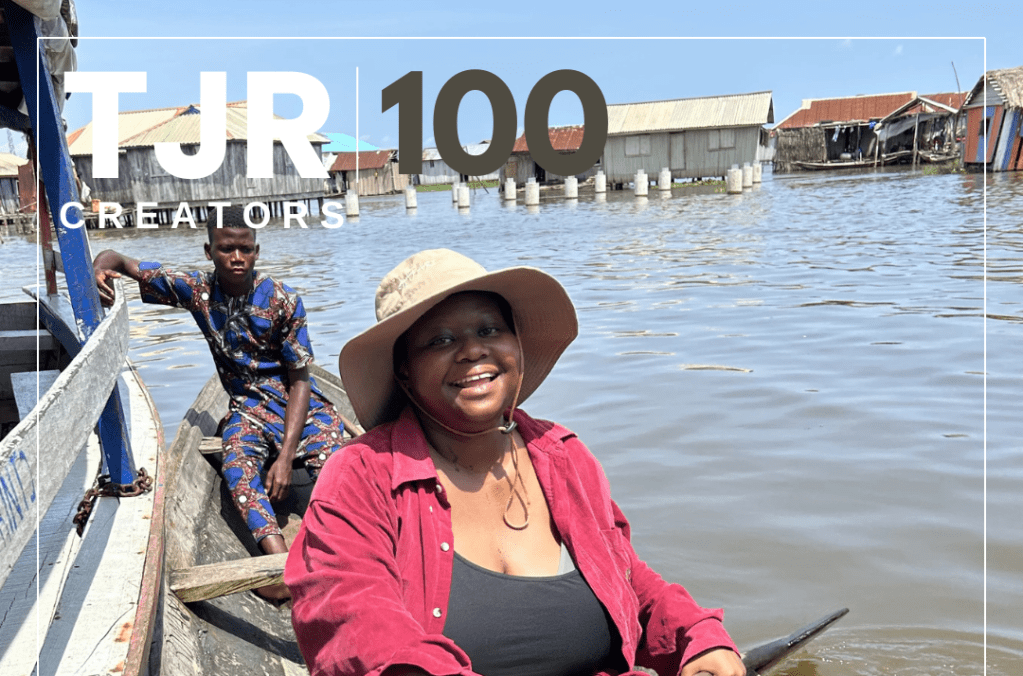
Sibiya has built The Popi Show around a simple but powerful curiosity: People. Her travels take her into communities, where she documents cultures and traditions while trying to experience them rather than simply observe them.
It’s a formula that has built an audience, and now there is growing interest in seeing the show reach an even bigger one.
This is her story.
What inspired you to become a travel vlogger?
I decided to become a content creator because I was tired of working for other people and advancing their businesses.
I used to teach English in China. I remember spending about 10 hours at work, although three of those hours were a lunch break. But the problem was that the lunch break was in the middle of the day, so I was still tied to the job and couldn’t really go and do my own thing.
I eventually found out that the school was making a lot of money from the students I was teaching. They were using my videos and other content to market the school, and I thought, “These people are making so much money from my work, and I have no time for myself.”
That frustration made me think about how I could use my own creativity to create something for myself. I thought I could do travel content creation, and I just knew people would be interested in it. I didn’t have a business plan, but I knew that if people watched it, I would eventually find a way to monetise it.
How do you go about researching and preparing for your travels to remote or lesser-known areas?
I actually don’t research or prepare that much because I want to have as much fun doing the show as the person watching it. I like the element of surprise.
I’ll see a video on TikTok or somewhere else, save it and come back to it later. I might only have a very basic idea of the country I’m going to. Once I get there, I want to find the people and document their way of life and experience it for myself.
I think what makes the show interesting for me is that whole process of searching and finding. That search is very important to me. If I already knew exactly what was going to happen — for instance, if I knew I was going somewhere and they were going to perform a particular dance for me — I would feel like I didn’t get the full experience.
How do you ensure cultural sensitivity and respect while interacting with the communities you visit?
People will usually tell me what’s good and what’s bad, and you also observe. You see what other people are doing and learn from that.
For me, it’s more about wanting to be part of the people and embody the experience rather than just standing outside and documenting it.
For example, when I was in Nigeria, I visited a Muslim community. I wanted to dress appropriately — not because anybody necessarily told me I had to, but because that’s what everyone else was doing. I would have been respectful even in my normal clothes if I had simply covered my head and legs, but I chose to dress that way because I really wanted to experience the community and see their society from as close to their perspective as possible.
Why do you think your content stands out from traditional travel content?
I think traditional travel content creates a particular expectation in people’s minds. They think of someone travelling from one destination to another, staying in hotels and showing beautiful places.
That’s not really what I’m doing.
I’m interested in people, cultures and communities. I’m interested in finding something that isn’t necessarily obvious to the person watching. The journey of finding those people and experiences is part of the show.
Can you tell us about a particularly eye-opening experience that changed your perspective on a certain culture or tradition?
The Lesotho girls’ initiation. I won’t reveal what happens there, but the community was welcoming and allowed me to participate in the process.
How would you describe what you do? Is “travel content creator” enough?
I think when people hear “travel content creator”, they have an idea of what that means, but if they haven’t watched every video, then they won’t understand what I actually do.
People hear “travel” and immediately think someone is just leaving the house and travelling from country to country. They don’t necessarily understand that what I do is much more specific and, in some ways, very obscure.
I’m travelling, but I’m travelling to people. I’m going into communities, finding people and experiencing their cultures and ways of life.
How do you decide which brands to work with? Do you ever turn down paying collaborations?
Look, the problem is that the pay is usually small. That’s one of the reasons you hardly see me doing brand work.
The other issue is alignment with The Popi Show. I don’t think a lot of people — even marketing managers and agencies coming up with campaigns — understand how to properly align products and brands with what I do.
Car companies approach me all the time, for example, but what they want is for me to join a convoy with other creators and drive somewhere. When have I ever done that? That’s not my content.
I’m usually being hosted in rural areas, experiencing cultures and traditions. I’ve never really been the person doing the typical influencer campaign where the brand just puts me in a car and sends me somewhere.
So there are very few brands where I feel there is a genuine alignment, and even fewer where the money makes sense.
Many people have called for The Popi Show to be on TV or a big international streamer like Netflix. Is this something you are taking seriously?
It’s something I’m definitely working on.
People have approached me wanting to collaborate on my existing show. They want to pitch it as a joint thing, and I’m always like, “No, I already have the show. The concept already exists.”
I don’t want someone to take the show away from me. I haven’t had the kind of proper offers where someone comes with a clear proposal that makes sense for me.
People will say, “Let’s go somewhere,” but that’s essentially what I’m already doing. I think once people understand what the show actually is, it will work out.
I also have to stand my ground because the show belongs to me. Someone might have been in the industry for years and produced award-winning programmes, but that doesn’t mean they need to own or control my concept.
People usually come to me with two propositions: either they have money, or they have connections and say they know people in television or production.
And I’m like, that’s great — you can use those connections to make a deal. But you’re not touching my show. I can produce the show and license it to you.
Nobody has come to me with a proper enough deal to make it worthwhile for me to stop the show or take it off my existing platform, even temporarily.
What safety advice would you give to aspiring travel vloggers who are interested in focusing on cultural exploration?
If you watch my work because you’re looking for a safety guide, you’re not going to get what you’re looking for. Safety isn’t really the core of my content.
I think people also forget that they aren’t necessarily as special or as different as they think they are. People are generally willing to tell you what’s good and what’s bad, and you can observe and learn from them.
For me, the important thing is being part of the people and the experience rather than simply arriving somewhere and treating the community as a backdrop.
What do you think about creators who increasingly rely on brand collaborations?
I think there is a problem when every other piece of content becomes an advertisement.
I remember seeing creators whose timelines were essentially filled with sponsored content. At some point you’re asking yourself, “Is this actually their life anymore?”
The problem with some creators is that brand work is how they pay their rent. They don’t necessarily have another revenue stream outside of selling things through their platform.
For me, content creation isn’t simply a means to an end where I have to constantly solicit sales. It’s its own thing.
Before content creation became a serious profession, people used to keep their day jobs while creating content on the side. I actually think that was quite nice because you got to see different sides of people’s lives without them having to overshare.
You might see someone working during the week and then going ziplining over the weekend. It was interesting because there was a separation between their professional life and their content.
What is your message to young South Africans ahead of the upcoming local government elections?
Research. Research. Research.
Don’t just look at one part of Cape Town, for example, and think that party is the answer. Do your research.
Look at how any party operates. What do they do right? What do they do wrong? Who do they tend to benefit, and who do they tend to benefit the least?
In South Africa, we focus so much on encouraging people to vote, but we don’t focus enough on encouraging people to read.
Read the articles that are written. Look at the issues. Do your research. Really open your eyes and don’t just vote because somebody tells you that this is the party you should support.
Quick Fire Qs
Last Netflix show watched?
The Polygamist.
Last song added to your playlist?
“Mary Jane” by Mary J. Blige.
Who do you want us to feature next? Nominate them here!


Leave a comment