An Ombud for South Africa’s anti-corruption unit sounds like exactly the kind of reform the country needs.
But it arrived only after the case against Lieutenant-General Dumisani Khumalo and seven co-accused had already fallen apart in public, after a magistrate hinted at no convincing evidence, and after the country’s chief prosecutor ordered the whole matter withdrawn.
What IDAC’s collapse shows is not that oversight failed. It is that oversight was never there when it mattered, and by the time it arrived, there was nothing left to protect.
On 10 July 2026, Justice Minister Mmamoloko Kubayi stood at the SALU Building in Pretoria and announced something that should, on the surface, be good news: an independent Ombud for the Investigating Directorate Against Corruption (IDAC), headed by retired Judge Takalani Raulinga.
For the first time since IDAC was created, the unit responsible for dismantling the country’s most complex corruption networks would itself have someone reviewing its conduct.
It is progress, on paper. But the timing tells a different story, one South Africa has heard before in other institutions.
The oversight body arrives once the damage is already done, the reputations already damaged, and in some cases the harm is already impossible to reverse.
An Ombud appointed after the case had already fallen apart
IDAC was established years before it was given any independent oversight. In that gap, critics say, it operated with almost no external check on its decisions to investigate and charge people.
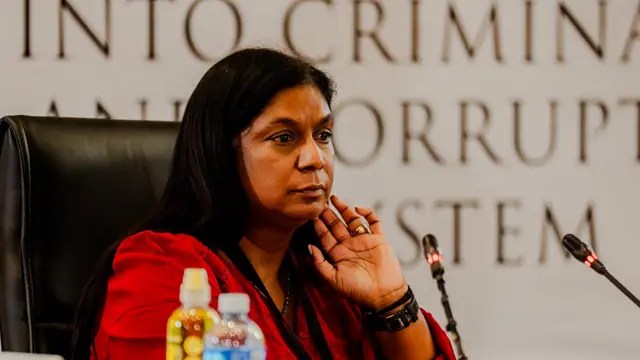
It took the Madlanga Commission, set up to look into criminality and political interference in policing and crime intelligence, to bring IDAC’s own conduct into public view.
What the Commission has heard is serious. Lieutenant-General Dumisani Khumalo, head of Crime Intelligence, and seven co-accused, including Major-General Nosipho Madondo, Major-General Philani Lushaba and Brigadier Dineo Mokwele, were charged by IDAC over the alleged irregular appointment of Mokwele to a senior technical role.
The appointment itself became a flashpoint after IDAC’s own head, Advocate Andrea Johnson, called it a “token appointment,” a description she later withdrew and apologised for, admitting she had never reviewed Mokwele’s qualifications before saying it.
In the last week of July 2026, National Director of Public Prosecutions Advocate Andy Mothibi went further and ordered the entire matter withdrawn, this followed his own review of the case.
Mothibi’s directive was specific: the case cannot be revived without his written approval, and if IDAC wants to reopen it, the accused must first get a fresh chance to respond. That is a clear statement of no confidence from the country’s chief prosecutor in his own specialised anti-corruption unit.
Then came the reckoning for Johnson herself. Under cross-examination at the Commission, she conceded that IDAC had no legal basis to investigate Khumalo in the first place.
On 27 July 2026, with President Ramaphosa’s approval, Johnson resigned with immediate effect. The resignation did not exempt her from continuing to answer for her conduct before the Commission.
The Ombud’s office opened seventeen days before the person occupying IDAC’s top seat was forced out. That is not an oversight arriving in time to prevent harm. It is an oversight arriving in time to inherit the wreckage.
Does an Ombud with no prosecutorial power actually change anything?
The next question is whether Judge Raulinga’s office can do anything meaningful about all this. The Ombud can investigate complaints of abuse of power and maladministration, but it is not a prosecutorial body.
It cannot undo a charge already laid, a career already interrupted, or a year spent defending a case that should not have existed.
Khumalo, Madondo, Mokwele and their co-accused were arrested, bailed, and put through a criminal process for over a year before the country’s chief prosecutor concluded the case should never have been brought.
The institutional damage was done well before Judge Raulinga’s office existed. Even Mothibi’s withdrawal was met with suspicion by the people it was meant to clear, because the process had already shown itself so unreliable that “provisional” no longer reads as reassurance.
South Africa has seen this pattern before. The Public Protector has issued findings that agencies simply ignored for years. The Special Investigating Unit has produced recommendations that led to no prosecutions.
The disbandment of the Scorpions, and the slow rebuild that eventually produced the Hawks and then IDAC, followed the same sequence: dismantle first, work out what oversight should have looked like only after something has gone wrong.
The Zondo Commission’s recommendations on state capture are, years later, still only partially acted on. An oversight mechanism announced in the middle of a scandal, however capable its head, risks becoming another entry in that list, a body that exists on paper without changing outcomes in practice.
One resignation, one unresolved system
There is a further problem worth naming plainly. The usual way institutional failure gets “resolved” in South Africa is for one individual to take the blame while the structure that allowed the failure stays untouched.
Andrea Johnson will carry the public cost of IDAC’s conduct. But she did not, on her own, design a unit with wide investigatory power and no external check for years. That was a legislative and executive decision made long before she signed any summons.
Her departure lets Parliament, the NPA leadership, and the Ministry that oversaw IDAC’s years without oversight move on: problem addressed, watchdog installed, next appointee in place.
The next appointee still inherits the same structural gap the Ombud’s office has only just begun to address. Johnson’s resignation, on its own, does not tell us whether IDAC’s successor will have clearer legal boundaries, better internal vetting of cases before they are charged, or a genuine check on charging decisions before an accused person is arrested and made to sit through a year of criminal proceedings.
The pattern is the real story, not any one person
None of this means Judge Raulinga’s office is without value. An independent complaints mechanism is better than none. But the timing says something about how South Africa builds accountability: reactively, publicly, and usually only after a commission of inquiry has already done the work of exposing the problem.
The real test of the IDAC Ombud will not be whether it exists. It will be whether, in a few years, another commission is not sitting in a hearing room asking why nobody caught the next case before it, too, went too far to undo.
Until that changes, every new oversight body launched in the aftermath of a scandal deserves the same plain question: does it come in time to prevent the next Khumalo, Madondo and Mokwele?
Nkosiyapha Trevor Tshabalala is a Director of Vana Tshabalala Attorneys and commentator on constitutional and administrative law.





Leave a comment