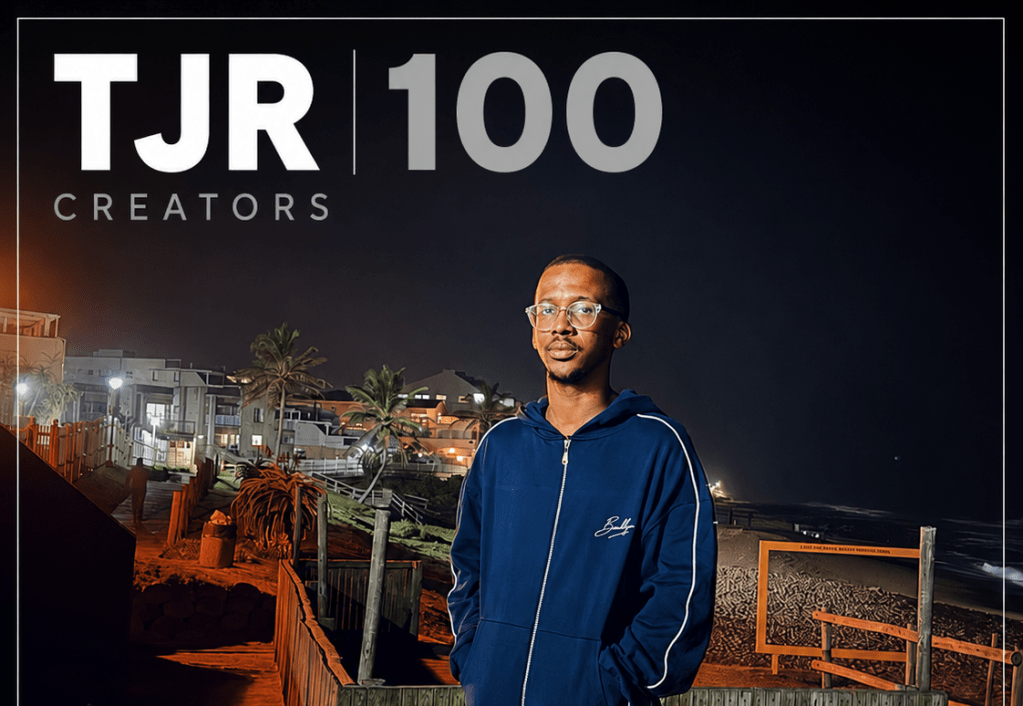
Not every food creator is simply chasing the next trending restaurant or viral dish. Matsobane Kgomo has built his platform by doing something far more meaningful: telling South African stories through food.
Whether he’s exploring hidden gems, unpacking the culture behind a meal, or making unfamiliar dishes feel accessible, his content reminds us that food is about far more than what’s on the plate, it’s about people, identity and belonging.
Originally studying Logistics and Supply Chain Management, Matsobane’s path into content creation was anything but conventional. A former aspiring musician, he found a new stage behind the camera, where his humour, curiosity and unmistakably local perspective quickly resonated with audiences.
Growing up in Siyabuswa, on the outskirts of KwaNdebele, also gave him a unique appreciation for the country’s diversity, something that continues to shape the way he connects with viewers from every corner of South Africa.
As part of our TJR 100 Creators campaign, we caught up with Matsobane to talk about finding purpose beyond his first dream, staying authentic in an algorithm-driven world, and why the best food reviews are often found in the comments section.
You studied Logistics & Supply Chain Management, but today people know you as a food blogger and culture storyteller. What was the turning point that made you choose content creation?
Matsobane: To be honest, I’ve always loved the idea of being in the media space but with the current rate of unemployment in South Africa, I had to make a decision to pursue content creation as long as it wasn’t anything aligned with illegal activities.
You said music was your first dream and that “the ship sank.” Do you see that as a failure or as a necessary redirection toward your current path?
Matsobane: I still love music and I appreciate it right now. It was a necessary redirection. The music we used to make was awful, but through content creation I’ve managed to collaborate with a few musicians on my videos, and that’s something I’m grateful for. Sometimes you don’t have to be the main star—you just have to play the role of someone appreciating the stars.
Growing up in Siyabuswa, what lessons from the hood still influence how you tell stories and connect with your audience today?
Matsobane: Siyabuswa is in the outskirts of KwaNdebele. Being Pedi and growing up in a predominantly Ndebele community taught me a lot about diversity. I’ve learnt how to connect with my audience through the common figures of speech we use in slang and tsotsi taal. Our English might not be perfect, but we’re learning to embrace it nonetheless.
Many creators focus on going viral. How do you balance authenticity with the pressure of social media trends?
Matsobane: I once tried going the route of always being viral, but I felt like I was losing my voice and identity, and that’s something I never want to experience again. My authenticity is one of the reasons I’ve managed to build a decent following. Media is about relevance, but you can also create relevance through your own authenticity.
You said the real reviews are in the comments section because that’s where South Africa speaks. What’s the most memorable comment or conversation your content has sparked?
Matsobane: South Africa is incredibly diverse, so the comments reflect that. You can read an offensive comment and a positive one within the space of a minute. The most memorable recent comment was from someone who said my content changed the way they approached food. They felt less insecure about not knowing how to pronounce certain dishes and started asking themselves, “Why can’t I just enjoy it?”
Food is more than just food; it’s history, identity and community. What meal or food experience has been the most memorable so far?
Matsobane: I’m actually answering this while I’m in KZN. My best experience has to be inyama yenhloko (cow’s head). It’s one of those dishes you can find across South Africa, but no province does it better than KZN. Food is linked to emotions, and emotions change, so one memorable experience can always be replaced by another.
Imagine you could invite any three South Africans to join you on a food tour. Who are you inviting, and where’s the first stop?
Matsobane: With all due respect, I don’t like dwelling on the dead. I’d rather focus on what’s realistically attainable. I’d invite my fellow streamer Tshepe, Slow 1F4OUR1 and Sleazy 012. Sleazy is very selective with his palate and people would laugh at how he explains why he’ll never eat certain things. It’s a weird combination, but it would definitely work because everyone’s work ethic is top tier. Our first stop would be Limpopo to eat termites.
What’s the one food you’ve reviewed that made you think, “There’s no way I’m eating this,” but then ended up loving it?
Matsobane: Sushi. I always assumed it was overrated, but I’m learning to appreciate it a lot more now.
When the camera is off and the phone is away, who is Matsobane?
Matsobane: I’m a quiet, straightforward guy. I’m not perfect, but my imperfections make me who I am. Like everyone else, I have my own battles, but I don’t let them define me. Most of my free time is spent listening to music and bonding with my family. With the younger generation coming up, I’m trying my best to show them that life is much bigger than what they currently know.
And if his story is anything to go by, the best journeys aren’t always the ones you planned, but the ones that help others see the world, and themselves, a little differently.
Who do you want us to feature next? Nominate them here!





Leave a comment