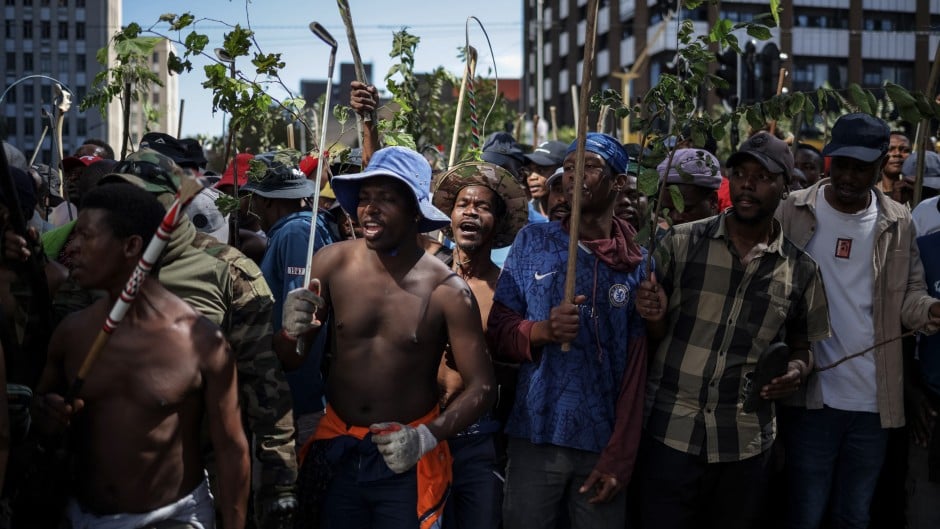
“We, the people of South Africa…”
The phrase was intended as a declaration of unity, a solemn constitutional invocation that would bind a fractured nation into a shared future governed by law, dignity, and the promise of transformation.
Today, those same words echo with a different resonance, one less ceremonial and more insistent, as if the people themselves are beginning to reclaim authorship over a project they feel has drifted from their hands, and in doing so, they are no longer merely invoking the Constitution, they are, in their marches, their gatherings, and their unrelenting presence in the streets, attempting to complete it.
Across South Africa, not only in Johannesburg, but in Durban, in Cape Town, in smaller towns where frustration travels faster than policy ever could, there is a movement unfolding that is neither centrally coordinated nor easily dismissed, a slow but unmistakable awakening of civic assertion born not out of ideological purity but out of accumulated neglect.
A phenomenon that reveals itself in the language of protest yet speaks more deeply of something far more consequential: a growing conviction among ordinary citizens that the state, once imagined as the primary vehicle of liberation, has become hesitant, reactive, and at times, perilously absent.
One must understand that these marches are not sudden eruptions of anger, nor are they reducible to the convenient labels of populism or disorder; they are, rather, the visible surface of a deeper current that has been gathering force over years, perhaps decades.
In the quiet indignities of everyday life, in the long distances travelled between home and opportunity, in the ceaseless search for employment that yields nothing but silence, in the small but cumulative betrayals of a system that promised transformation yet delivers it unevenly, hesitantly, and too often, not at all.
If one seeks empirical grounding for this frustration, one need only turn to the stark realities that define the present moment: an official unemployment rate hovering above 32%, and a youth unemployment rate exceeding 60%, figures that are not merely economic indicators but social fault lines, signalling a generation suspended between qualification and exclusion, between aspiration and stagnation, a generation that will soon be asked to return to the ballot box in the forthcoming local government elections, where the question will not simply be who governs, but whether governance itself retains credibility in the eyes of those who have waited the longest for its benefits.
To walk through these protests, if one listens carefully, is to hear not only slogans but stories, not only demands but exhaustion, an exhaustion that has settled into the bones of the nation, an exhaustion born of waiting, of being told that change is coming while the present remains stubbornly unchanged, of watching institutions falter while rhetoric grows ever more elaborate, until finally, patience itself becomes unsustainable.
The people, in their own imperfect and sometimes troubling ways, begin to act; and in that action, one detects not only anger but fear, for South Africa is also a country grappling with one of the highest crime burdens in the world, recording over 27,000 murders annually, with violent crime rates that have remained persistently high, such that insecurity becomes a daily calculation rather than an occasional concern, shaping behaviour, movement, and ultimately, the sense of whether the state can fulfil its most basic obligation, to protect life.
There is, within this moment, something profoundly instructive, for what we are witnessing is not merely dissent but a reconfiguration of authority, a subtle yet significant shift in which the boundaries between state and society begin to blur, as communities organise patrols where policing has weakened.
As civic groups assert control where governance has receded, as the line between lawful protest and extra-legal enforcement becomes increasingly difficult to distinguish, not because citizens inherently reject the rule of law, but because they experience that law as distant, inconsistent, and at times, irrelevant to their immediate conditions; and this perception has been deepened not only by the Zondo Commission on State Capture, which exposed the systemic looting and institutional hollowing that undermined governance at its core.
Other inquiries, the Marikana Commission, which laid bare the tragic consequences of state failure in managing labour conflict; the Life Esidimeni Arbitration, which revealed a devastating collapse of care and accountability; and the State Security Agency review panel, which exposed the politicisation of intelligence structures, each of these forming part of a troubling mosaic in which the state is repeatedly shown to falter at moments where it is most required to act with competence and integrity.
History, if it is to be taken seriously, offers ample warning of such moments, for it has long been observed that when states lose the capacity to mediate conflict, to deliver services, and to maintain credibility, parallel forms of organisation emerge, not necessarily to overthrow the state, but to compensate for its absence; and in that compensation lies both necessity and danger.
For a while such movements may arise from legitimate grievances, they operate outside the disciplined structures that ensure fairness, restraint, and accountability, and thus risk transforming frustration into force, and force into a form of legitimacy that no constitutional order can comfortably accommodate, a concern that echoes in the jurisprudence of the Constitutional Court itself, where Justice Madlanga, reflecting on the nature of constitutional accountability, has cautioned against a state that allows its own failures to undermine the very rights it is constitutionally obliged to realise, reminding us that rights without implementation risk becoming hollow promises rather than lived guarantees.
In South Africa, this dynamic is further complicated by the harsh arithmetic of scarcity, for one cannot ignore the simple yet devastating reality that the economy has failed to absorb its people, that unemployment has become not merely a statistic but a defining condition of existence, shaping identities, relationships, and possibilities in ways that are both visible and deeply internalised, and within such a landscape, competition becomes inevitable, attaching itself to whatever is most immediate and most visible.
Often manifesting in tensions around immigration, informal economies, and access to opportunity, not because these are the sole causes of economic distress, but because they provide a tangible focus for frustrations that are otherwise diffuse and overwhelming; and layered atop this is the enduring question of land, where despite decades of reform policy, it remains the case that a disproportionate share of productive agricultural land is still held by a minority, while millions of South Africans live without secure tenure, in informal settlements or precarious housing conditions, a reality that underscores how incomplete the project of redistribution remains and how deeply the legacy of dispossession continues to structure present inequality.
It is here that the broader African context must be confronted with honesty, for South Africa’s position within the continent has long been one of relative stability and opportunity, attracting those seeking refuge from conflict and economic hardship elsewhere; yet this dynamic, left unmanaged and insufficiently addressed at both national and continental levels, has produced a situation in which the burden of regional inequality is disproportionately borne by a country already struggling to meet the needs of its own citizens, thereby placing strain not only on resources but on the very idea of pan-African solidarity, which risks fracturing under the weight of unmet expectations and uncoordinated responses.
And still, at the centre of this unfolding reality, stands the state, present, yet often belated; responsive, yet rarely anticipatory; eloquent in its articulation of challenges, yet inconsistent in its resolution of them, so that a pattern emerges with troubling clarity, one in which crises are addressed only after they have escalated.
Where interventions follow rather than prevent, where leadership appears most visibly in moments of breakdown rather than in the quiet, sustained work of prevention, planning, and delivery, thus reinforcing a perception that governance has become reactive, shaped more by events than by intention, more by pressure than by foresight; and nowhere is this more evident than in the persistent failures of service delivery, where municipalities collapse under financial mismanagement, where water systems fail, where refuse goes uncollected, where electricity supply becomes unreliable, and where communities, left with no alternative, turn to protest as the only remaining language through which to demand attention.
The consequences of such a pattern are not merely administrative; they are deeply psychological, for legitimacy, once eroded, does not collapse dramatically but dissipates gradually, in small increments, as citizens begin to recalibrate their expectations, to rely less on formal institutions and more on informal networks, to seek solutions not through established channels but through immediate action, until eventually, the question is no longer whether the state is capable, but whether it is necessary.
One might consider, in this regard, the lived experience of a young South African, educated, aspirational, yet persistently excluded from the economy, who observes the dissonance between promise and reality, who hears the language of transformation yet encounters its absence in daily life, who watches as resources are misallocated, opportunities foreclosed, and accountability deferred, and who, in the face of such contradictions, finds in collective action not only a means of expression but a form of agency that the formal structures of the state have failed to provide.
Such a moment is not easily dismissed, nor should it be, for it represents a critical juncture in the life of any democracy, a point at which the distance between law and lived experience becomes too great to ignore, and where the continued reliance on historical explanation, however valid, begins to lose its persuasive power in the absence of corresponding progress, not because the past has ceased to matter, but because the present has become too urgent to defer.
South Africa, it must be said, is not yet a failed state, but it would be equally mistaken to assume that its trajectory is secure, for the signs of strain are evident in the weakening of institutional capacity, the inconsistency of service delivery, the rise of private alternatives to public goods, and the growing inclination among citizens to act independently of the structures designed to govern them, all of which suggest not collapse, but erosion, a slow wearing away of the foundations upon which democratic legitimacy rests.
The task before the state, therefore, is neither abstract nor optional; it is immediate and exacting, requiring a restoration of capacity, a recommitment to enforcement, a clarity in policy, particularly around immigration and economic inclusion, and above all.
A shift from reactive posture to proactive governance, such that the state is not perpetually responding to crises but actively preventing them, not merely articulating challenges but systematically addressing them, not relying on the endurance of its citizens but justifying their trust through consistent and tangible delivery, particularly at a moment when the electorate prepares to return to the polls in local government elections that will serve, in many respects, as a referendum on whether the promise of democratic governance still resonates with lived experience.
For if there is one lesson that history offers with unforgiving clarity, it is that nations do not unravel because their people protest, but because their institutions fail to respond in time, and in that failure, allow frustration to harden into disillusionment, and disillusionment into a form of action that no longer seeks permission from the state, but proceeds despite it.
And so we arrive at a moment that demands not rhetoric, but recognition, not denial, but decisiveness, for the marches that now traverse South Africa’s cities and towns are not merely expressions of anger; they are signals, warnings, and perhaps most importantly, claims, claims to dignity, to opportunity, to a state that is present, capable, and responsive, and if those claims continue to go unmet, then the question will no longer be whether the people are stepping in, but whether the state, in its hesitation, has already stepped aside.
“A nation does not fracture in a single moment; it frays slowly, thread by thread, until one day it realises that what once held it together has quietly come undone, and that the people, in their urgency, have begun to weave something else in its place.”






Leave a comment