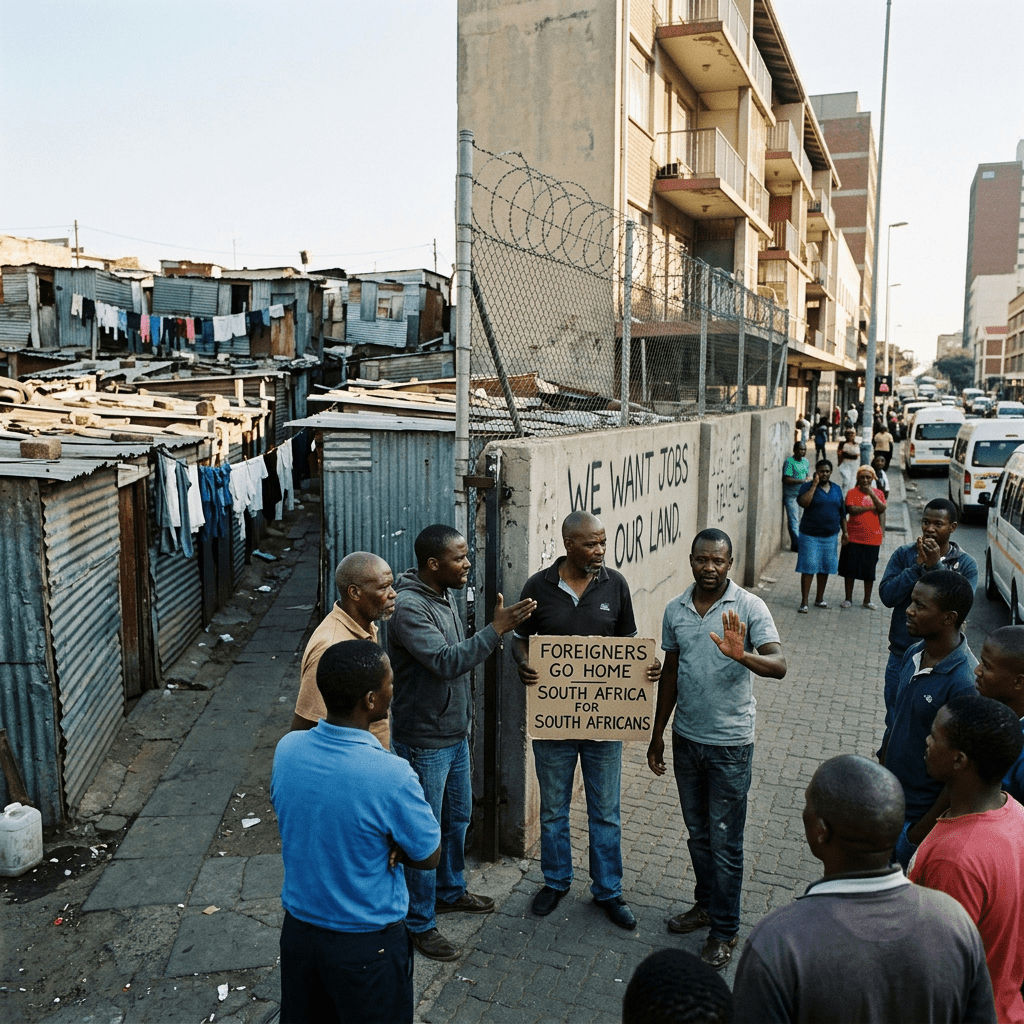
The Debate Around Illegal Immigration
A variety of individuals and groups, both local and foreign, are actively working to undermine the efforts of local organised groups to confront illegal immigration into South Africa.
Their arguments often deflect from what many consider to be the central issue: the struggle over limited public resources in what is widely regarded as the world’s most unequal country. Instead, they frame the debate as merely a contest for low-skilled jobs, overlooking the broader context in which native South Africans, particularly those living in historically neglected, under-resourced, and poorly serviced villages, townships, and deteriorating urban centres, continue to bear the consequences of both past and present governance failures.
Official data from Statistics South Africa shows that foreign-born residents, many of whom are undocumented, consistently exhibit higher employment and labour absorption rates than South African-born citizens. However, these jobs are often concentrated in lower-paying or informal sectors that lack adequate labour protections.
While compliance with domestic labour and immigration legislation is essential, focusing solely on low-skilled employment distracts from the broader challenge posed by illegal immigration: competition for limited public resources between undocumented immigrants and native South Africans, driven by government inaction and misaligned policy priorities.
Post-Apartheid Spatial Shifts
Following the end of apartheid and the repeal of the Group Areas Act during the late 1980s and early 1990s, wealthier white residents gradually moved out of South Africa’s adequately serviced and economically viable inner cities.
Their departure created opportunities for some black South Africans, alongside many foreign migrants, to settle in these areas in search of affordable housing, improved access to public services, and greater economic opportunities.
Areas such as Hillbrow, together with many other inner-city neighbourhoods in Gauteng and across the country, underwent significant demographic changes, transforming from affluent, white-dominated enclaves into densely populated centres commonly described as pan-African “ports of entry.”
These neighbourhoods now host substantial populations of foreign-born residents from countries such as Zimbabwe, Mozambique, Nigeria, the Democratic Republic of the Congo, Angola, Malawi, and many others.
Many are undocumented, of uncertain legal status, or have obtained documentation through fraudulent or corrupt means.
Following this demographic shift, this new population found itself benefiting from apartheid’s spatial planning by residing closer to economic opportunities and state-provided services, including primary, secondary, and specialised healthcare, well-resourced public schools, and tertiary institutions.
In contrast, many native South Africans were, and continue to be, relegated to labour reserves known as townships, such as Alexandra—geographies that were historically excluded from these advantages. Even within these spaces, residents now compete with generally undocumented immigrants for access to already limited public resources.
Township settlements were never intended to become self-sustaining economic hubs.
Their primary purpose under apartheid was to supply cheap labour for the advancement and sustainability of white capital, hence their historical under-resourcing. Although apartheid has ended, this pattern of uneven spatial and economic development persists today.
Post-Apartheid Labour Dynamics and Spatial Displacement
Following the end of apartheid, there was a noticeable decline in the exploitation of native South African labour.
In some sectors, this pattern of exploitation was replaced by the employment of immigrants, who increasingly occupied roles previously held by native workers who were now protected by labour legislation.
Despite relying on immigrant labour for economic gain, many of those benefiting from this arrangement have resisted the integration of immigrants into their own residential communities, much as they historically resisted the integration of poor black South Africans.
Consequently, many immigrants settled in former white city centres, townships, villages, and informal settlements—areas already characterised by intense competition for limited public resources.
This has intensified existing tensions between native South Africans and immigrants and helps explain the growing popularity of organised groups opposed to illegal immigration among sections of the native population, despite criticism from those who benefit economically from immigrant labour.
Central Place Theory and Spatial Injustice
To further illustrate these dynamics, this discussion employs Central Place Theory. The theory posits that settlements are spatially organised and interact economically in ways that maximise accessibility for surrounding areas. Ideally, cities develop organically to provide equitable access to goods, services, and economic opportunities.
However, South Africa’s apartheid planners deliberately distorted this model by reinforcing segregation through the manipulation of central economic nodes to isolate and exploit marginalised native populations as sources of cheap and expendable labour.
| Concept | Central Place Theory | Apartheid Manipulation |
| Hierarchy of Settlements | A rational, equitable distribution of resources, with villages serving towns and towns serving cities, allowing free access to goods and services. | An imposed, racialised hierarchy with affluent, white-dominated “core” cities as primary centres, and black townships relegated to the economic and geographic periphery. |
| Thresholds & Ranges | Minimum population required to sustain a service (threshold) and maximum distance people will travel (range) to access it. | Townships were designed with low-density, uniform housing and denied economic and commercial facilities, deliberately limiting local business thresholds. |
| Market Areas (Hexagons) | Market areas form nested hexagons to ensure maximum efficiency and full geographical coverage without overlaps or gaps. | Rigid physical “buffer zones” such as industrial areas, railways, or undeveloped land strictly separated racial groups, preventing urban market integration. |
| Centrality & Accessibility | Core centres naturally develop for maximum accessibility, serving the population evenly. | Access was heavily restricted through “influx controls,” the Group Areas Act of 1950, and the pass law system, making central economic nodes nearly inaccessible to black South Africans. |
Resource Competition and Government Inaction
Native South Africans have endured decades of under-servicing under both apartheid and the democratic era.
Many have become increasingly frustrated that individuals who entered the country illegally, or who obtained legal status through questionable means, are able to access public services located within cities that continue to benefit from apartheid’s untransformed spatial legacy.
Although these urban advantages remain deeply unequal, competition for education, healthcare, housing, and other basic services now extends into townships as well, intensifying pressure on already limited public resources.
Rather than addressing these concerns proactively, the government is often perceived as being inactive or merely reactionary, while at times appearing to target the grievances of native South Africans instead of addressing their underlying causes.
This creates fertile ground for non-state actors to capitalise on both contemporary frustrations and historical injustices. These dynamics increasingly manifest in attempts to prevent migrants from accessing public healthcare facilities, schools, and other state-provided services.
Notably, such confrontations are largely absent in white, middle-class and affluent communities, where residents predominantly rely on private healthcare, private education, private security, and other privately funded services.
By virtue of their economic resources, these communities are largely insulated from direct competition over public services and can effectively afford social stability through economic buffers.
The R600 million budget allocated to manage a single march reflects what many perceive to be misplaced state priorities. Rather than addressing historical inequalities through meaningful spatial transformation and visible enforcement of existing immigration legislation, the state appears more concerned with managing domestic and international perceptions.
This perception widens the gap between political leaders and ordinary citizens, increases the power distance between the state and the public, and creates fertile ground for the continued emergence and growth of non-state actors focused primarily on illegal immigration, both now and in the future.
Subscribe below to get notified when Part 2 of this piece comes out!




 The Joburg Reporter
Leave a comment