“A nation does not rise on speeches, nor is it sustained by the poetry of its leaders; it rises on systems that work, on institutions staffed with competence, finances stewarded with prudence, infrastructure maintained with foresight, and laws administered with integrity. It rises where ambition is matched by capacity, and where the promise of the Constitution is made tangible in the lived experience of its people.”
South Africa arrives at the State of the Nation Address on 12 February 2026 with a paradox in its pocket. The Republic looks calmer than it did at the height of rolling blackouts and inflation panic. Prices have cooled. The lights, mostly, have stayed on. Markets are not in revolt.
Yet beneath that surface stability lies a harder truth: the economy is still crawling, unemployment remains a national wound, and at the municipal coalface, where the state meets the citizen, pipes burst, bills go unpaid, and trust thins.
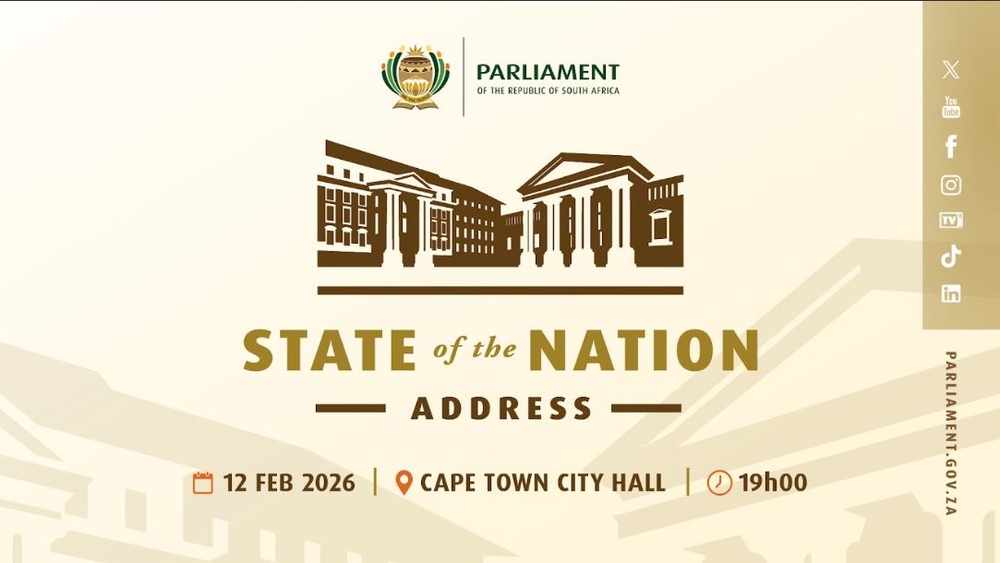
President Cyril Ramaphosa will stand at Cape Town City Hall at 19:00 and perform the Constitution’s annual ritual: to recount achievements, acknowledge challenges, and outline the year ahead.
But SONA 2026 will be judged less on the elegance of its themes and more on whether it narrows the credibility gap between state ambition and state capacity.
Put bluntly: promissio must yield to executio.
Stabilisation without escape velocity
The stabilisation story is real.
Inflation averaged 3.2% in 2025 and ended the year at 3.6% year-on-year in December. Treasury and the South African Reserve Bank have agreed to a lower inflation target of 3%, with a ±1 percentage point band, an unmistakable signal of “lower-for-longer” ambition, if credibility holds.
Fiscal authorities have tightened their belts. Government debt is projected to stabilise at 77.4% of GDP in 2025/26. But that stability comes with a heavy price: debt-service costs will consume 22 cents of every rand collected in revenue. Before a single teacher is paid or a kilometre of pipe replaced, nearly a quarter of state income goes to servicing yesterday’s borrowing.
That is not trivia. It is the Republic’s binding constraint.
And growth? Treasury’s projections are sober: 1.6% in 2026 and 1.8% in 2027. This is not breakout velocity. It is managed fragility. It is movement, but not momentum.
Stabilisation is a necessary condition for renewal. It is not renewal itself.
Energy relief- and the logistics veto
Electricity, once the defining symbol of state failure, has eased as a crisis. The CSIR’s national statistics show a sharp drop in load-shedding between 2023 and 2024, with 281 consecutive days without load-shedding recorded by the end of last year. After years of economic self-sabotage by blackout, that matters.
SONA will almost certainly claim this as proof that reform in network industries can yield dividends. And it would not be wrong. But electricity is a gate, not a destination. An open gate still leads nowhere if the road beyond it is broken. That broken road is logistics.
Treasury itself warns of the “persistence of logistics constraints.” The World Bank describes container ports as critical nodes in supply chains, where time is cost. South African ports have been publicly ranked among the worst performers globally. When vessels wait, exports stall. When cranes idle, competitiveness evaporates.
In political economy terms, logistics is a veto point. You can stabilise inflation. You can reform visas. You can preach investment. But if goods cannot move with speed and reliability, growth is taxed before it even begins. A credible SONA cannot merely celebrate energy relief; it must speak the language of throughput, rail slots, crane moves per hour, vessel turnaround time, corridor reliability. Metrics that can be audited, not merely applauded.
The Republic’s fault line: employment
If SONA 2026 has a single moral metric, it is employment.
The official unemployment rate stood at 31.9% in the third quarter of 2025. The broader measure, counting discouraged jobseekers, was 42.4%. Youth unemployment remains devastating: 58.5% for those aged 15–24. Nearly half of young South Africans aged 15–34 are not in employment, education, or training.
Unemployment dwarfs every other public concern. Survey data show it is the dominant priority in citizens’ minds. It is not simply an economic statistic; it is a psychological condition.
Section 22 of the Constitution guarantees the right to choose a trade, occupation or profession freely. But rights can become parchment if the economy cannot absorb labour. Freedom of choice means little when opportunity is structurally scarce.
Here political maturity is required. Public employment programmes cannot substitute for private-sector labour absorption at scale. Relief is not the same as mobility. The transition must be from temporary work to durable productivity; from compensation to catalysis.
Treasury’s own thesis is clear: faster, inclusive growth that creates jobs requires reform across energy, water, logistics, and critically local government performance. Jobs require growth. Growth requires throughput. Throughput requires capable institutions.
Where the state fractures: municipalities
It is in local government that macro stability meets micro failure.
Only 16% of municipalities achieved clean audits in 2023/24. Nearly half adopted unfunded budgets. The system haemorrhaged billions through water and electricity losses. Municipalities owe Eskom and water boards tens of billions. Consumer debt stands at over R416 billion, most of it owed by households. Municipalities themselves owe creditors R131.8 billion most of it more than 90 days overdue.
This is not an accounting curiosity. It is the anatomy of failing maintenance.
When revenue systems collapse and creditors go unpaid, infrastructure decays. Pipes burst. Pumps fail. Outages normalise. Citizens absorb the cost through private coping, storage tanks, bottled water, generators, lost hours of work. Public failure becomes a private tax. Public opinion reflects this fatigue. A large majority say the country is heading in the wrong direction. Most are dissatisfied with their municipality’s performance. The civic imagination, belief that tomorrow can be better than today, erodes under such strain.
Johannesburg: a case study in fragility
Johannesburg’s water crisis crystallises the problem.
In early 2026, a chain of infrastructure failures, from pump stations to treatment plants, left parts of the metro without reliable water for days. Reservoirs ran critically low. Protests erupted. Emergency repairs followed emergency repairs.
Yet the crisis did not begin in January. Johannesburg Water’s own figures show non-revenue water at 46.2% nearly half the water in the system lost before billing. The city faces a multi-billion-rand infrastructure backlog. Rand Water’s abstraction limits are tightening. Demand regularly exceeds allocations.
The margin for error is thin. When non-revenue water approaches 50%, every burst pipe becomes a macroeconomic event.
Constitutionally, national government cannot simply “take over.” Municipal autonomy is protected. Intervention routes are structured through provincial escalation mechanisms. The Water Services Act allows the Minister to request provincial intervention when a water authority fails, but the architecture is legal, not impulsive.
Citizens may demand command-and-control. The Constitution demands process.
Which returns us to SONA’s central test: will it acknowledge that structural design, operational weakness, and fiscal constraint intersect and bind itself to measurable repair?
Incremental movement, uneven terrain
To claim that nothing works would be analytically false.
Home Affairs has advanced digital visa systems. Sexual offences courts have expanded. The health system has launched campaigns to close treatment gaps in HIV care.
The state can still move.
But delivery is most visible where mandates are clear and accountability tighter. Municipal water remains the hardest terrain, fragmented, politicised, financially stressed.
The politics of credibility
This SONA unfolds under a Government of National Unity. Coalition politics brings both stability and fragility. The GNU has framed its work as reformist and responsible, even as opposition parties attack it as incoherent or austere.
Public sentiment is less interested in coalition metaphysics than in outcomes. Cooperation is broadly supported, if it produces results. The electorate is not grading ideology; it is grading throughput.
The risk for SONA 2026 is not dishonesty. It is dissonance, the widening gap between declaratory ambition and administrative execution.
From recital to contract
A turning-point SONA is not one that sounds grand. It is one that binds itself to a delivery logic: baselines, targets, timelines, named institutions.
It would publish a delivery scorecard and update it quarterly.
It would tie every new promise to a funding source, acknowledging the 22-cent debt-service constraint.
It would release public dashboards on port and rail performance.
It would convert employment relief into structured absorption pathways.
It would condition municipal bailouts on financial reform and enforce consequence management.
It would demand ward-level transparency on Johannesburg’s water losses and burst backlogs.
It would pre-agree legal escalation protocols before crisis, not during it.
In other words: it would transform speech into an auditable contract.
The closing arithmetic
SONA always ends the same way. Ceremony disperses. Markets reopen. Opposition drafts rebuttals. Households return to the arithmetic of groceries, transport fares, job searches, and, too often, dry taps.
The Constitution’s Preamble does not ask South Africans merely to endure. It asks the state to improve the quality of life and to free the potential of each person.
Mandela’s maxim, “It always seems impossible until it’s done” is both inspiration and warning. The impossible becomes done only when institutions are staffed, funded, measured, and held to consequence.
Stabilisation has bought South Africa breathing room. Structural reckoning will determine whether it uses that oxygen to run or simply to tread water.
SONA 2026 must choose which.
Leo Maphosa is a legal and governance analyst based in Johannesburg whose work examines the architecture of constitutional democracy, fiscal stewardship, and the political economy of state capacity. He writes on the disciplines that separate promise from performance – institutional reform, public finance, infrastructure governance, and the mechanics of administrative execution. He believes South Africa’s renewal rests on capable institutions, ethical leadership, and a social contract anchored in accountability, consequence, and measurable delivery, where ambition is matched by competence and stability is converted into shared prosperity.





Leave a Reply