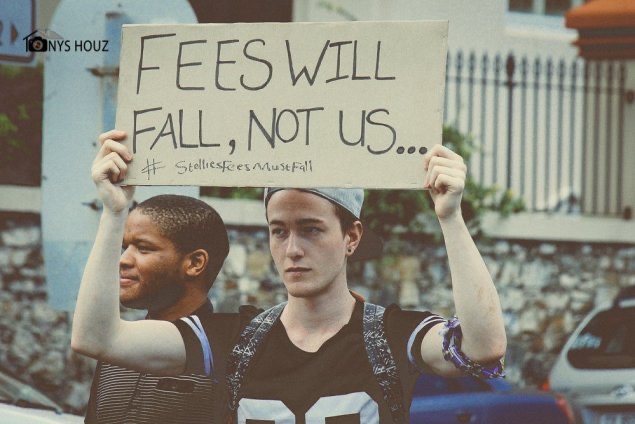
This month and year marks ten years since the #FeesMustFall movement took place – In mid October 2015.
There was general unrest that raged across public university campuses as students protested the periodic cycle of tuition adjustment(s) by Councils’ increases aligned to or above ‘higher education inflation’, signalling further inaccessibility of university education – mobilising under the slogan #FeesMustFall, demanding “free, decolonised education”, a twin objective.
The volatility ceased and relative normalcy rebounded in December 2017, when the state President, Jacob Zuma (Mr), pronounced “free education”, which implied that, students from households earning R350 000 – 00 or less will be eligible as beneficiaries, effective from the academic year set to start the following month, January of 2018.
This position taken against recommendations from the Heher (chaired by Justice Arthur Heher) Commission of Inquiry into Higher Education and Training in South Africa, established in 14 January 2016, under section 84(2)(f) of the Constitution of the Republic of South Africa, and tasked to “investigate the feasibility of making higher education and training fee – free in South Africa”.
The Heher Commission made several recommendations, in the 752 page report submitted on the 30 August 2017, that: increase block funding; minimise deficit in student accommodation; introduce online – blended learning; funding for TVETs; income contingency loans for postgraduates and graduates who still owe institutions; NSFAS business plan be retained.
undergraduate and postgraduate students studying at both public and private universities and colleges, regardless of their family background, be funded through a cost-sharing model of government guaranteed Income-Contingency Loans sourced from commercial banks; and that registration fees be scrapped.
In a nutshell, the “fees commission” recommended some changes within the broader context of a sustained neo – liberal outlook to higher education in the republic. Marginalised students would later reject those recommendations.
The Heher Commission’s mandate was solely on “affordability”, ‘free education’, not decolonised education and neither did the announcement on December 2017 speak to that.
This implied a limited response to the twin demands submitted by students, not just to those elected to be law makers but to the entire post schooling and education sector. However, before exploring post – colonial transformation of South African universities, its important to first round up the free education praxis.
The theory of affordability and access (abolishment of financial barriers to entry) to higher education did not entail a percentage upward adjustment to the Value Added Tax (‘VAT’) – which implied poor and working class families would experience diminished disposable income to indirectly fund offspring from that class, not necessarily household, to “access” university.
It did not imply a threshold of a first qualification only and continued financial struggle in articulation; it did not include the exclusion of the fragile middle class and neither a fixed R350 000 – 00 threshold not adjusted for inflation; and it also did not include an unstable implementation institution, the NSFAS, that continuously experiences high turn over of its board and executive managers along with other structural and systematic instabilities that work at the detriment of its beneficiaries.
The current status quo and model is in such a way that payment still exists, indirectly from the state and previously disadvantaged households.
This is not to argue that wider access has not been achieved post December 2017, but rather to state that the objective has not limited “wider access” but, universal access to higher education for everyone – an opportunity to pursue post-secondary education, regardless of background, socioeconomic status, or any other (potential) barrier to access.
education shall be free, compulsory, universal and equal for all children; Higher education and technical training shall be opened to all by means of state allowances and scholarships awarded on the basis of merit- The Freedom Charter (1955) ; Everyone has the right to further education, which the state, through reasonable measures, must make progressively available and accessible – Constitution of RSA (1996).
It’s clear that the promise pre – post – democracy by the then liberation movement, later ruling, and now majority party and state was not limited access or excuses of fiscal constraints and limited absorption capacity.
The students’ central demand for “free decolonised education” draws on two elements of what a scholar Grosfoguel (2011) names the “colonial power matrix”, namely: 1) economic; and 2) epistemic oppression.
Students raised grievance on continuous failure by South African universities to act as a public, transformative good and instrument, but instead remained the bastions of what striking students perceived as white, western cultural and economic privilege – institutions of epistemic colonial relic, dominant neo – liberal and neo – western cultural ideology which remain strongly entrenched and largely unresolved.
The 2015 to current situation in post-apartheid South Africa as a post – colony and its relation to “global coloniality” is nuanced and complicated – compared to other previously colonised nations, given the powerful remnants of colonial and apartheid structures, systems and hegemonic social practices that still aggressively permeate and inform our current society.
Simplified, it’s probably much easier to frame the nature of post-apartheid South Africa as a choice between two historic competing political schools of thought, what some scholars characterise one as the “Mandela paradigm” and the other as the “Biko paradigm”.
The Mandela paradigm is defined as a mediated settlement with white oppressors, it represented a moral victory for its said peaceful, non-violent transfer of power.
The reconciliation and non-racialism, rainbow nation, underpinned by the approach is epitomised in the 1996 South African Constitution.
The Biko paradigm however is perceived to be less conciliatory, considering the “negotiated settlements” of the early 1990s as only an intermediate step, means to an end, towards the full liberation of native people.
Mandela’s imagined post-apartheid and post – colonial South Africa, considered in this perspective, is a political subterfuge for sustaining minority privilege and rule in various guises, with the Constitution ensuring legal shield and armoury.
Biko was much more ambivalent than Mandela about the role white people would play in South Africa after apartheid.
While he did not want them to leave he indicated that their contribution would be proportional and on “terms laid down by blacks”; such an approach would inform the post – colonial social contract that would inform every sphere of society, case and point, higher education institutions – from ontology, epistemology, and axiology; third or rather hidden curriculum, dismantling of the western canon and ensuring real and tangible transformation – not accommodation and deliberate ubiquitous assimilation with intent to distract and defocus.
With this 10 – year commemoration of #FreeEducation – its important to mention that there has been some changes here and there – some universities have made noises about “transformation”, Africanisation, investing in indigenous knowledge systems, developing indigenous languages for academic exploitation, social justice and other “progressive” initiatives to affirm the native and develop contextually relevant knowledge to address challenges faced by local communities yet, on the contrary, academics and administrators at the pinnacle of knowledge production and administration in higher education institutions find themselves conflicted.
On one end, there’s expectation to demonstrate epistemic freedom in the production of knowledge from their centralities and unique positionalities (epistemic location) and the other end, they are limited by pervasive influence of neoliberalism – a paradigm that dictates to them that the production of knowledge should be subservient to market dynamics.
Over the years there has been a strategy to systemically de – radicalise and de – conscientize the student population as means to mitigate risk of “disruption” of not just the core business but also the dominant status quo of an institution hence voices of dissent and continued call for decolonisation fade with each passing generation, so has collectivism, giving rise to individualism in thought and in action – sustaining neo – liberalism, reformism and at other institutions conservativism; transformation within a colonial context.
The journey ahead is still long, may the class of 2015 never be forgotten!




 The Joburg Reporter
Leave a comment