
I am a patriot and tourism advocate who envisions South Africa as a warm, welcoming nation, a world-class destination for all. The uncomfortable truth is that our tourism industry, while vibrant, often overlooks entire sections of our population. This isn’t just a failure of empathy; it’s a missed economic opportunity.
I work in the Insights unit at SA Tourism, the “home of truth” that uses data to provide insight to move us forward with a deep love for our audiences. Our mission is to transform curiosity into advocacy by delivering unforgettable experiences defined by quality, care, ease of access, and great value.
This mission is guided by South African Tourism’s (SA Tourism) core values, best captured by my personal favourite: Authentic Caring.
Tourism is hospitality at its heart; it’s about creating a welcoming environment where everyone feels free to explore. SA Tourism’s campaign, ‘Come find your Joy,’ invites travellers to see South Africa through the eyes of a child. And as any parent knows, that requires extra care, patience, and attention.
This is where our incredible tour guides come in. As the essential curators of our destination, their role is integral to delivering on our promise. The data confirms we are on the right path, showing that tour guiding scores have steadily improved over the last two years. This progress is a testament to our collective commitment to genuine, caring service.
“The guiding profession plays a powerful role in shaping how visitors experience South Africa. We are not just storytellers, but also cultural ambassadors, safety stewards, and often the human connection that turns a trip into a lasting memory.
One of the greatest opportunities we have is to professionalise the sector further by encouraging continuous training, digital literacy, and deeper collaboration with local communities to bring more authentic, inclusive experiences to the forefront. We’ve seen how meaningful, well-informed guiding can shift perceptions, build emotional connections to a place, and even influence return travel or referrals.
By investing in the upliftment and visibility of guides, we not only elevate the profession but also significantly enhance the value and richness of South Africa as a tourist destination”, notes Dale Jacobs, Branch Manager at Hylton Ross Cape Town.
Tour guiding is a crucial aspect of the tourist experience, and the satisfaction of international tourists with tour guides has increased ahead of the overall satisfaction in the past two years. Overall satisfaction with South Africa as a destination was 4.57 in 2022 and was up to 4.58 and 4.61 in 2023 and 2024, respectively. Momentum has slipped back in the first quarter of 2025, with only Western Cape and Limpopo trending upward in the first three months.
Similarly, only Australasia, North America and Europe show an uptick. While the decline in overall tour guiding satisfaction is down to the levels of 2022, it is important to note these are directional trends but are not statistically significant.
Overall satisfaction with the destination compared with the satisfaction with tour guides, 2024, taken from the SA Tourism Departure Survey (below).

The increase in satisfaction with Tour Guides over the period from the full years of 2022 and 2024 is most clearly driven by tourists who visited Mpumalanga, Gauteng, Free State, KwaZulu-Natal and Limpopo. With only Mpumalanga, Gauteng, and Limpopo improved further.
The satisfaction with tour guides by province, 2024, taken from the SA Tourism Departure Survey (below).
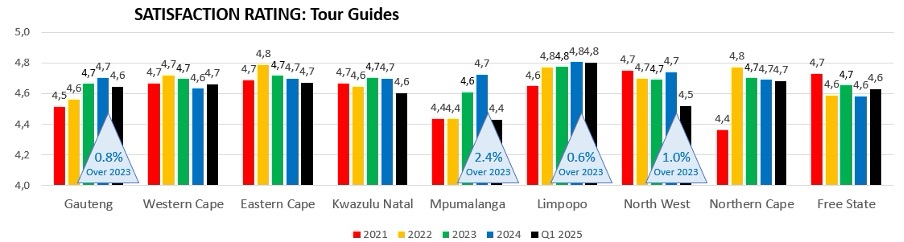
Tour Guiding scores are in decline across most regions with Africa Land and the Middle East showing improvements and Australasia remaining relatively the same. Tour Guides are a key driver of overall destination satisfaction for the air markets. Tourists from Africa Land alone have higher overall satisfaction than their satisfaction with Tour Guides.
The satisfaction with tour guides by region, 2024, taken from the SA Tourism Departure Survey (below).
“Tour guides are not just storytellers; they are frontline ambassadors of South Africa’s heritage, culture, and identity. There is a great opportunity in professionalising this space — not to make it rigid, but to give it the dignity, training, and recognition it truly deserves. One challenge I encounter regularly is how packed and unrealistic many itineraries are, leaving no room for tourists to truly absorb the richness of our landscapes or connect with our communities. Instead of creating space to breathe in a view, reflect in silence, or engage meaningfully, many experiences are reduced to ticking boxes and taking pictures. Perhaps therein lies an opportunity for ground handlers and local operators to become more proactive in selling immersive, balanced, and culturally respectful itineraries to DMOs and DMCs, where quality of experience is prioritised alongside delivery. If we want meaningful tourism, we need to guide the experience — not just the route.” Lee-Marque Jansen – Founder and Owner (Streamline Tourism Marketing and Events)
Despite these wins with improvement in guiding by several provinces and for tourists in the different regions. We have to continue to challenge ourselves and raise the bar again. This tourism month’s theme is on Sustainable Transformation. I am not going to give you numbers to cheer or pat ourselves on the back. I come with questions to drive us into the future.
Building a Truly Inclusive South Africa
True transformation requires more than diverse suppliers; it demands a radical reimagining of who our services are for. The tourism products and experiences we offer must be tailored to meet the diverse tastes of individuals from all backgrounds, taking into account factors such as race, gender, culture, religion, language group, and those living with disabilities. We proudly showcase our museums, tours, and accommodation services, but are they accessible to all?
How do we welcome blind tourists or include deaf family members at heritage sites when we lack braille signage or sign language interpreters? This isn’t abstract—it’s personal. A trip to Robben Island was a stark reminder: a deaf cousin could enjoy the boat ride and the ocean breeze but was locked out of the museum’s history.
If our own families struggle with inclusion, how can we expect the sector and nation to succeed? We also have to deal decisively with racism and sexism, elitism and classism within the spaces as well. The expectations that remain unspoken about dress codes and behaviours need to be expanded to be more open to people from different backgrounds whose meaning-making is very different from ours.
There remains a huge demand for language guides for Arabic and Mandarin-speaking tourists, along with guides that have a broad global knowledge base and can accommodate different cultures and nuances.
Other European languages also have challenges with finding younger tour guides bi-lingual and proficient in languages like German, Italian, Spanish and Portuguese. This includes the way products are configured to cater almost exclusively to the tastes and diet of the consumers of the East and Global South.
This is a call to action to centre the least privileged:
- Rethink Experiences: We must redesign services, from tourism to emergency response services like the police and fire brigade, so that the blind, deaf, and wheelchair users receive equal dignity and care. How do voice-impaired /vocally challenged citizens call the police – are there alternatives, and are these accessible?
- Empower People: Train staff to be equipped and confident in welcoming everyone. Along with the empowerment comes the possibility for employment and business inclusion in a wide variety of specialities. Instead of threatening to replace people with AI, we provide training to staff and organisations on how to integrate and enhance consumer experience with the AI tools, and find opportunities to make operations more efficient and effective.
- Fulfil Our Promise: This is more than ethics; it’s a growth opportunity that creates jobs and builds the inclusive society our Constitution envisions. Barriers to entry entrench the inequality and therefore limit our destination appeal and opportunities for growth because of crime and safety concerns.
Let’s move beyond mere compliance to genuine belonging. By choosing to build a world where everyone can feel the ocean breeze and access the history, we break new ground and prove that an inclusive South Africa is not just a dream, but a promise we can finally keep.
A Research Program for the Economic Imperative of Inclusive Tourism
True inclusivity is not just a moral duty—it’s a powerful economic strategy. Instead of asking how to accommodate people with disabilities, we must ask: how do we actively build an industry that includes and prioritises them? Beyond that, we need to reimagine the confines of what is and what is not tourism. Also who we imagine the tourist is and where they are from. There is a big and brave new world of opportunities to explore and we have to be brave and ask the right questions, use sound methodologies and philosophically diverse approaches of understanding
This means making data-led decisions to transform good intentions into measurable impact. We must invest in local businesses that manufacture braille signage and accessible infrastructure, creating jobs here rather than importing solutions. We need dedicated research to quantify the value of the special needs travel market and develop specialist operators and training providers to serve it.
By centring this community in our campaigns and experiences, we do more than grow our market; we combat the ignorance that fuels discrimination. This is the essence of sustainable transformation: building a tourism industry that leaves no one behind, proving that inclusion and economic growth are powerful allies. We can broaden the perspective of what a guide is, going beyond the language and story to the quality of care they provide and their ability to include everyone. This is the evolution we need and the bravery to keep going despite the temptation of short-term profits.
South Africa remains among the top destinations to visit; we are number one or two on the continent, but… If we get what I am saying right, we become a family reunion market for any extended family group with differently abled people. We continue to lead on the continent as a LGBTQIA+ friendly destination due to the legal protections for the community, and become the de facto event destination for complete freedom and inclusivity.
To be welcoming of all different cultures and religions, and show our authentic diversity while being open to tourists from everywhere in the world, and warmly embrace them for who they are. See, I may not be sure if this is the correct terminology, there are mistakes on the journey of discovery, and wouldn’t it be beneficial to the country if we all learned together? You want to be relevant, here is how to care authentically, don’t be so shallow… Free your mind, the tourist volume and value will follow… The benefits of being inclusive will make the circle bigger and surprise us with the benefits further down the line.
Mbongeni K Dhliwayo – Regional Insights Specialist
Sources: SA Tourism Departure Survey
Other related SA Tourism thought leadership:
Inclusivity-trends-report – SouthAfrica.net
Halaal-tourism-infographic – SouthAfrica.net
Dry-tourism-trend-report – SouthAfrica.net
 The Joburg Reporter
Leave a comment