Fiat justitia ruat caelum.
This ancient maxim is not a quaint Latinism to be rolled out at ceremonial occasions. It is, or ought to be, the very backbone of any society committed to the rule of law. And yet, in this hour of national disquiet, when truth jostles with spectacle, and law competes with populist outrage, one must ask: do we still mean it?
The past few weeks in South Africa have been nothing short of a juridico-political theatre. Advocate Malesela Teffo’s now-notorious interview made waves across the country, waves so forceful they threatened to drown out sober reflection. With names cascading like confetti, and insinuations whispered with the authority of gospel, the public was gripped, appalled, and enthralled in equal measure.
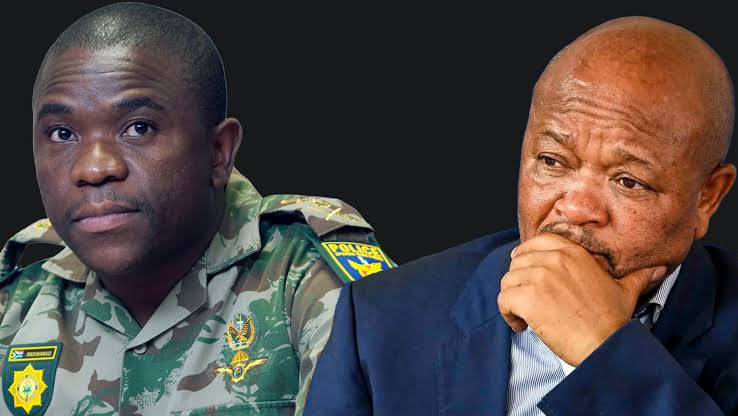
But Teffo’s was not the only voice stirring the hornet’s nest. On 6 July 2025, KwaZulu-Natal Police Commissioner, Lieutenant-General Nhlanhla Mkhwanazi, delivered what may come to be remembered as one of the most damning disclosures from within the state’s own security architecture.
ALSO READ: RECAP: President Ramaphosa ‘Takes Action’ Following Mkhwanazi Allegations
In a bombshell media briefing in Durban, he alleged not only political interference in criminal investigations, but the existence of a syndicate embedded within the structures of the state, colluding with criminal networks and undermining constitutional authority.
And so, the question is no longer whether we are living through a constitutional crisis. The question now is how we respond to it, legally, ethically, institutionally, and intellectually.
The Legal Duty to Discern
In moments such as these, when sensational claims collide with entrenched disillusionment, the role of the legal fraternity becomes both more difficult and more indispensable. It is tempting, almost seductively so, to accept every dramatic revelation at face value, especially when made against a backdrop of long-standing institutional decay. But the law, as an enterprise, demands more than mere resonance. It demands rigour.
We are taught, firmly and early, that probability does not amount to proof (S v Blom 1939 AD 188). Circumstantial evidence, while often compelling, must be consistent with all established facts and exclude all other reasonable inferences. Multiple versions, no matter how colourfully delivered or publicly received, do not automatically coalesce into fact.
The current climate, however, is one of epistemic chaos. The public court is in constant session, where hashtags replace heads of argument, and the rules of evidence are dispensed with in favour of vibes, virality, and visceral outrage. In such a climate, even the legal profession, supposedly the last bastion of dispassionate logic, is at risk of losing its compass.
Yet we are reminded by the Constitutional Court that legality and administrative rationality are not optional virtues, they are constitutional imperatives. To jettison these principles in the name of populist justice is to sacrifice the very ground on which true justice must stand.
The Mkhwanazi Moment: When Allegation Becomes Institutional Self-Indictment
Still, some moments transcend mere allegation. General Mkhwanazi’s revelations fall into that category. This was no fringe dissident or political malcontent.
ALSO READ: Paul Mashatile’s Appearance On SMWX Is A Vote of Confidence In SA Podcasts
This was a sitting Provincial Police Commissioner publicly asserting that the Minister of Police, Senzo Mchunu, together with allies like Brown Mogotsi and Vusimuzi “Cat” Matlala, had undermined the Political Killings Task Team, disrupted 121 high-profile investigations, and conspired, through improper tenders and private WhatsApp correspondence, to shield a criminal enterprise embedded in law enforcement.
As he put it:
“The disbandment of the task team was not a mistake. It was a deliberate attempt to shield an organised criminal syndicate deeply rooted in our law enforcement, political, and judicial systems.”
To the legally trained mind, such words are not merely scandalous, they are seismic. They do not assert a suspicion; they unveil a betrayal of constitutional duty at the highest level. They compel not only public interest, but urgent legal inquiry.
Indeed, if the Mkhwanazi disclosures are even partially true, then the rule of law has not merely been compromised, it has been taken hostage.
Teffo’s Voice, Mkhwanazi’s Echo: Between Possibility and Proof
And here lies the subtlety that must not be lost. Teffo, in his own erratic way, may very well be voicing a deeper, more intuitive truth: that justice in South Africa is often delayed, diluted, or diverted. His version of events may be exaggerated, even flawed, but it cannot simply be dismissed. Mkhwanazi’s statement lends credence to the possibility that, within the noise, lies signal.
This is precisely why due process must prevail. Not to exonerate the guilty. Not to protect elites. But to ensure that justice, when it does arrive, is not vulnerable to reversal, revision, or repudiation. As Lord Atkin famously said in Liversidge v Anderson [1942] AC 206:
“Amidst the clash of arms, the laws are not silent.”
Nor should they be amidst the clamour of headlines.
Reconstruction and the Moral Economy of Law
In 1994, President Nelson Mandela spoke of the need not merely for economic reconstruction, but for a Reconstruction and Development Programme of the Soul. That phrase, often neglected, now returns with prophetic urgency.
The revelations of the past weeks have exposed a rot that is more than structural, it is spiritual. It is the rot of impunity disguised as power; of public institutions hollowed out from within; of justice subverted by expediency.
And so we must do more than reform. We must recalibrate. The President, the NDPP, the Chief Justice, and the heads of Parliament must treat this not as political fallout to be managed, but as a constitutional emergency demanding extraordinary response. The judicial commission into Mkhwanazi’s claims must not be a symbolic exercise but a forensic intervention, backed by prosecutorial resolve and parliamentary scrutiny.
ALSO READ: The Legacy of Alcohol Abuse in South Africa
Let Lady Justice Rise
This is not, and must not be misconstrued as, a defence of those named or implicated. It is, rather, a defence of the legal method itself, of the presumption of innocence, of the right to be heard, and of the sacred imperative to think before we convict.
Let Lady Justice rise from the ash, not blind to corruption, but clear-eyed in procedure. Let her scales weigh not sentiment, but substantiated truth. And may her sword fall, not at the behest of hysteria, but in fidelity to the Constitution we swore to uphold.
Fiat justitia ruat caelum — let justice be done, though the heavens fall.
But let it be justice rooted in reason, rendered in law, and remembered in history, not as performance, but as principle.



 The Joburg Reporter
Leave a comment