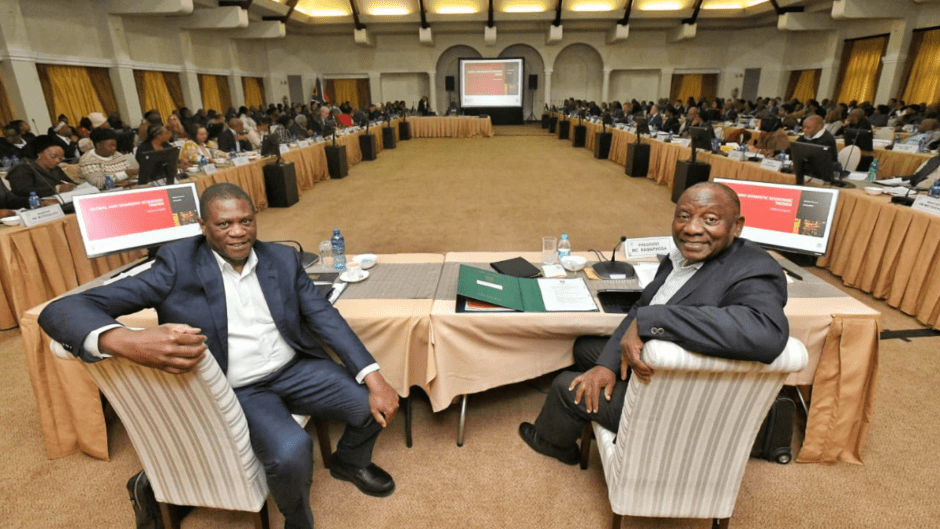
Ten parties in the 7th democratic Parliament voted in support of the proposed budget. The budget was presented by the Minister of Finance, Enoch Godongwana, on 12 March 2025. This is in opposition to the 8 parties. These include GNU partners Democratic Alliance and the Freedom Front +. They voted against the budget, and this caused a rift in the government of national unity (GNU).
Talks to reconfigure the GNU have begun and amidst these, is the often ignored issue of a bloated cabinet. The size and cost of the executive burdens taxpayers. As the country braces for the increased VAT, a more fiscally responsible approach is needed. This approach must align government spending with the everyday realities faced by South Africans. It must be strongly considered.
The budget proposed two increases in the standard rate of the Value Added Tax (VAT) of the country. The first rate of 0.5% increase scheduled to come into application from 1 May 2025, and the second rate increase of 0.5% will apply from 1 April 2026.
This coupled with a third financial year of bracket creep, is counterproductive – weighing down on household disposable income, making income tax less effective. The Consumer Confidence Index plunged to negative 20 in the first quarter of 2025, the lowest point since Q2 2023, down from negative 6 in the previous period.
Cabinet – Cost to Employer
South Africa under the government of national unity expanded the cabinet to 32 – Ministers and 43 – Deputy Ministers –
- Each Minister has 11 staff members with a cost of employment totalling R8 441 583 per Minister per year, and R270 130 656 per year for the 32 Ministers
- Each minister earns no less than R2 690 000 per annum and 32 ministers generating R86 080 000 per annum
- Each Deputy – Minister has 7 staff members with a cost of employment at R4 934 734 per year and multiplied by 43 Deputy – Ministers sums to R184 673 562
- Each Deputy Minister earns not less than R2 215 000 which sums up to R95 245 000 for the 43 Deputy Ministers
- Ministers, Deputy Ministers and their direct private office staff cost R636 129 218 per annum.
- Ministers have provision according to section 12A of the Public Service Act, 1994, read with the Dispensation for the Appointment and Remuneration of Persons (Special Advisers) Appointed to Executive Authorities on Grounds of Policy Considerations in terms of Section 12A of the Public Service Act, 1994 (“the Dispensation”), may appoint 2 special advisors – The range is from Compensation level I – Salary level 13 to Compensation level IV – Salary level 16
- With addition of Special Advisors the total cost would reach a minimum of R714 005 954 a year
These estimates were determined using entry level salaries for government SMS (senior management service) Remuneration Scales and Public Service Act Appointees not covered by OSD (Occupational Specific Dispensations), that is, entry salary level and first notch from the scales provided by the Guide For Members Of The Executive.
Additional Cost to Employer
Relocation
This cost is a once off, designed to assist the appointed members with the following:
- Relocation of physical assets (private or state residence for official purpose)
- Transporting of personal belongings, furniture, motor, vehicles, pets
Security
- Security analysis of the Member’s private residence(s) and Official Residence(s)
- Close security
- Personal security and –
- Static security – maximum of 3 residences of the appointee
- Members may have one official residence per seat of office
Staff
The staff here is the same staff mentioned of which the minimum expenditure was calculated –
- Private office
- 7 staffers to the Minister and 5 to the Deputy Ministers
- Staff at official residence
- 2 per Minster and 2 per Deputy Minister
- Departmental support – Special Advisors
- Maximum 2 per Minister
Equipment
Office furniture and other movable equipment required by the Minister and the Deputy Minister is factored into the total cost estimate.
Official Motor Vehicles and Air Travel
Ministers and their deputies have prescribed benefits afforded to them and extended to their staff and kin –
- National Members shall be provided with one vehicle for official use in each seat of office.
- Spouses and other dependent family members, including dependent children of a member may, subject to availability, be transported in the member’s official vehicle by the member’s driver, aide, or SAPS VIP driver/protector.
- Members and their spouses (or an adult family member accompanying the Member in an official capacity) are entitled to travel for official purposes at the expense of the relevant Department.
Counting The Cost
Clearly – the total cost is significantly above R714 005 954 when included the other cost item such as security, accommodation, travel, furniture and more. These costs are distributed to various departments such as the respective department of the official, Public Works, the SAPS and others. It’s important to note that the estimated cost excludes the President and Deputy President. When added, they round up the cabinet.
Its safe to say that the cost will average above a billion rands per year and over five billion by the end of the term if everything is held constant – a significant cost to the South African taxpayer.
As the GNU engages to find alternative means around the budget impasse and reconfigure the coalition, it is important that they discuss the expenditure item. They should actually move to downsize the cabinet. This is one of the ways to demonstrate solidarity with South Africans who will feel the pinch in their pockets as a consequence of decisions taken by the state.
Bongani K Mahlangu is a B Com Economics, B Com Honours Economics and Master of Commerce in Economics graduate from the North – West University. Has worked in Banking, Competition Commission of SA, public sector and in advisory. Often serves as a political economic analyst and commentator on radio and television networks


 The Joburg Reporter
Leave a comment